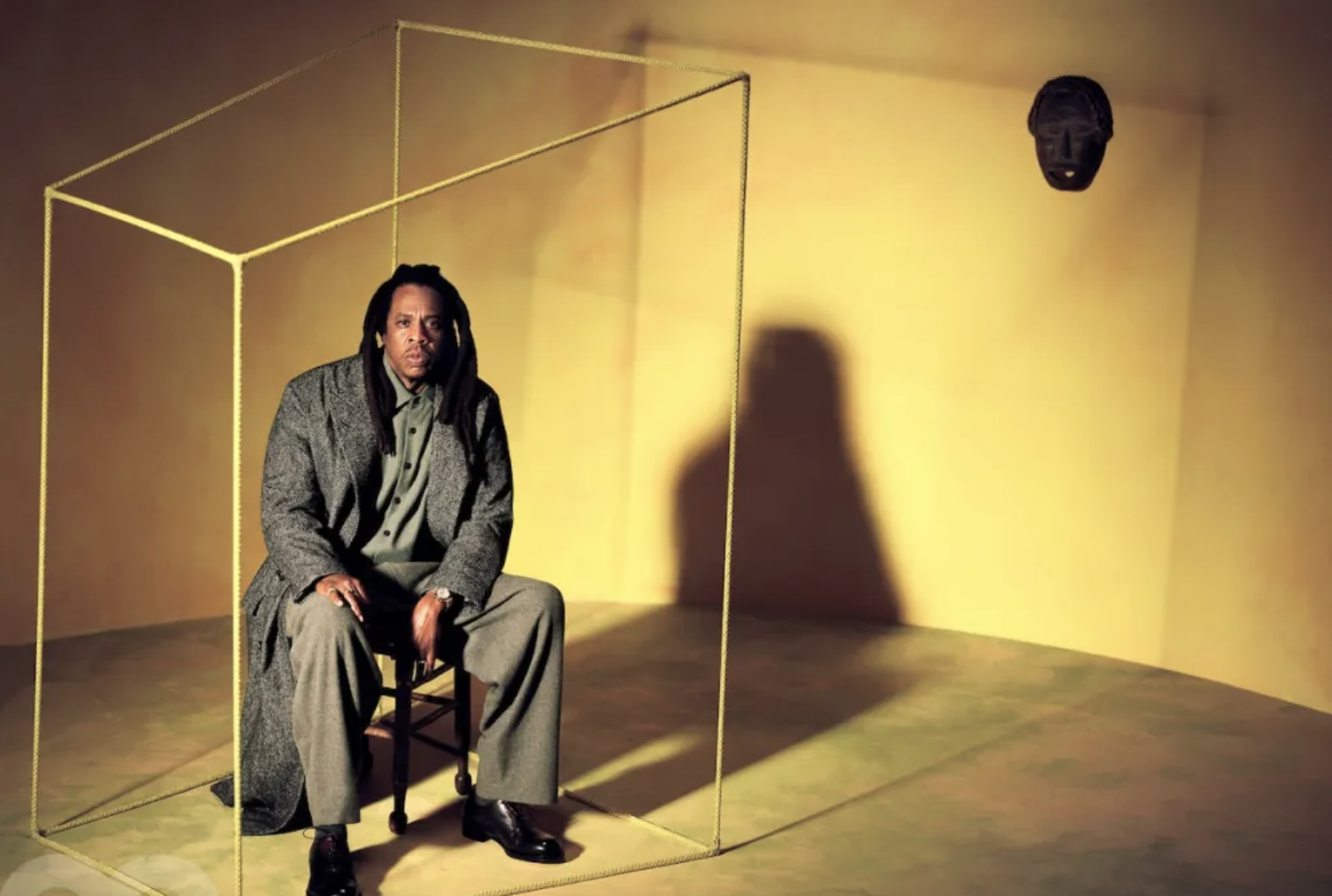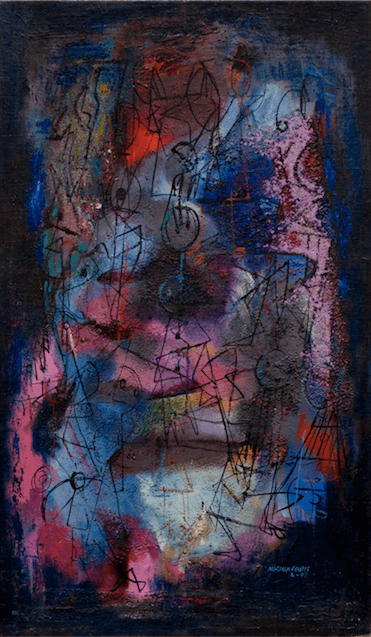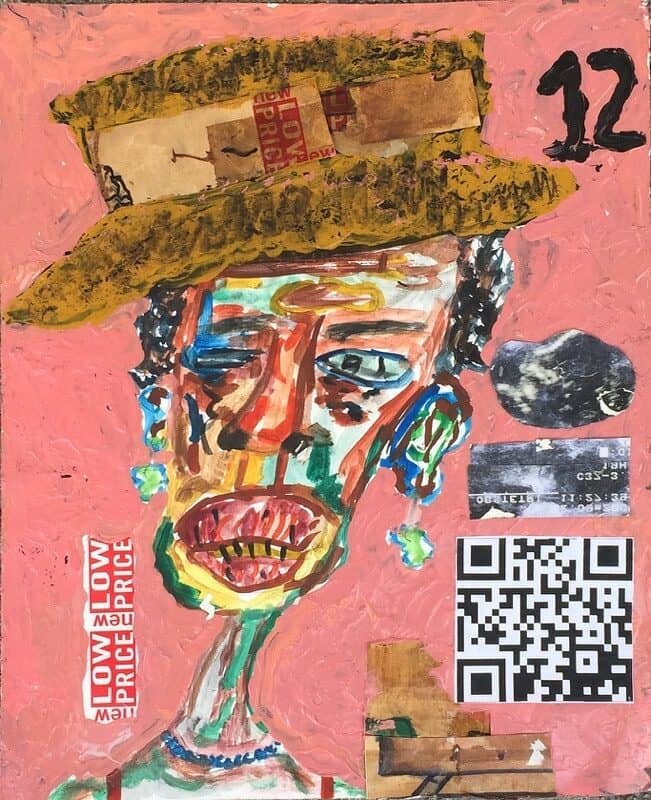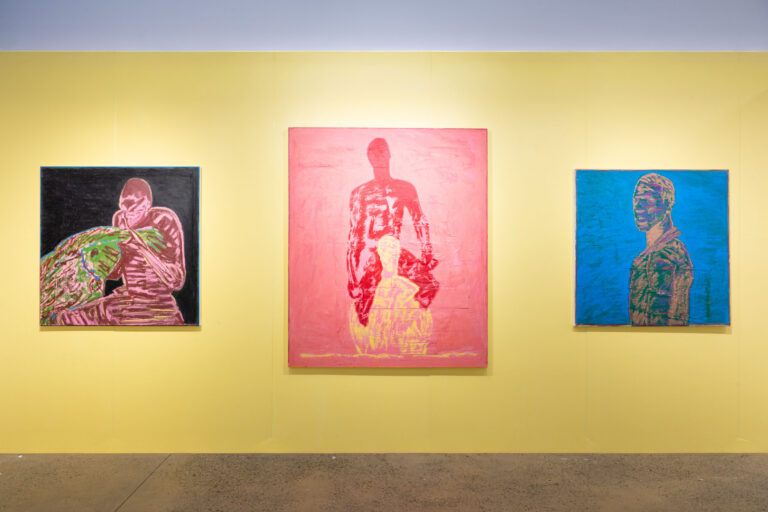


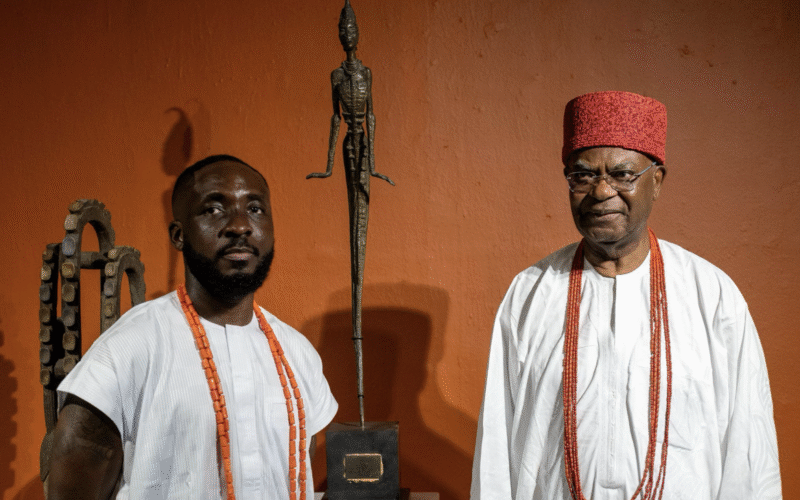
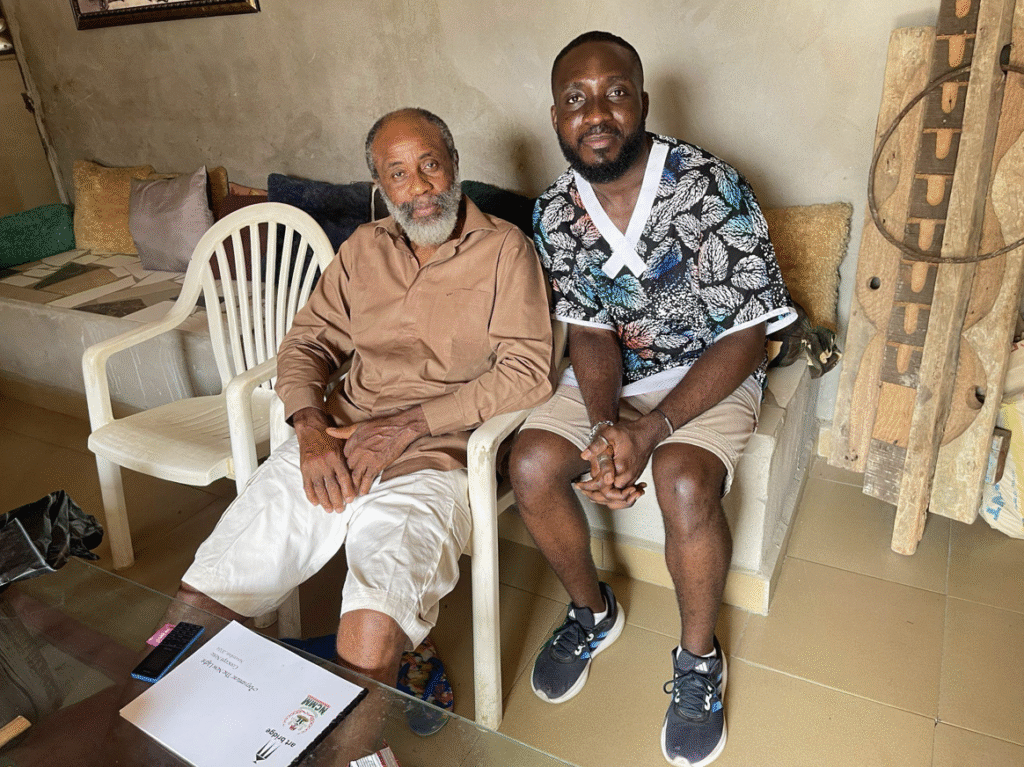
Above: Tony Agbapuonwu (left) and the Obi of Onitsha (right) at Anyanwu: The New Light preview | 2025 | Photo credit: Ugochukwu Emeberiodo
Odinigwe Benedict Chukwukadibia Enwonwu, also known as Ben Enwonwu, was an Igbo-Nigerian artist whose painting and sculpture predominated Africa’s art scene in the 20th century. Anyanwu, his bronze sculpture bears a close resemblance to the titular dancing male figures in his Ogolo series. This series features masked spirits with origins from Onitsha, Nigeria, Ben’s ancestral home.
Tony Agbapuonwu started the journey of curating Anyanwu: The New Light in 2024. He consulted works of Nigerian artists who contributed immensely to the art and culture space when the young nation newly gained independence during the mid-1900s. Some of these artists included Aina Onabolu, Akinal Lasekan, Ben Enwonwu, Uche Okeke, Demas Nwoko, Bruce Onobrakpeya, Yusuf Grillo and members of the Zaria Art Society. Ben Enwonwu’s Ogolo series and Anyanwu in particular inspired him to revive some of their guiding philosophies through a careful selection of contemporary art.
Agbapuonwu began curating ten years ago. While pursuing a degree in creative arts from the University of Lagos, he started his career as an art writer for The Sole Adventurer. In 2015, he was a curatorial intern at Art Twenty One. He started Art Bridge Project in 2017, a personal project for exposing young artists to the realities of the Nigerian art scene, especially art students at the University of Lagos and Yaba College of Technology. After graduation, he joined the marketing and curatorial department at ART X Lagos in 2018.
In 2022, he joined Kòbọmọjẹ́ Art Residency as their residence and onsite program manager a position he has held to the present. In 2023, he joined Red Heritage, an art intervention program, as a program manager. In 2024, he managed Abiodun Olaku’s solo retrospective show. In August 2025, he was selected as a laureate for the RESONANCE curatorial residency by ART X Lagos, Cité internationale des arts, and the Embassy of France in Nigeria. Agbapuonwu has worn multiple hats across these roles and is still focused on strengthening locally led art institutions in Nigeria.
Art Bridge Project, his nonprofit art organization, supports this vision by organizing exhibitions and workshops for students, artists and the general public. Anyanwu: The New Light, is their most recent exhibition, with collaborative efforts from the National Commission for Museums and Monuments (NCMM), ADEGBOLA Art Projects, National Council for Arts and Culture, Ime Obi Onitsha and 1-98 Art Studio.
I conversed with Tony Agbapuonwu about his curatorial process for Anyanwu: The New Light.
Rejoice Anodo (RA): What inspired you to curate Anyanwu: The New Light?
Tony Agbapuonwu (TA): It is both personal and historical. Isi mbido, the beginning point, was a very close meditation on Ben Enwonwu’s paintings. I am fascinated by his Ogolo series.
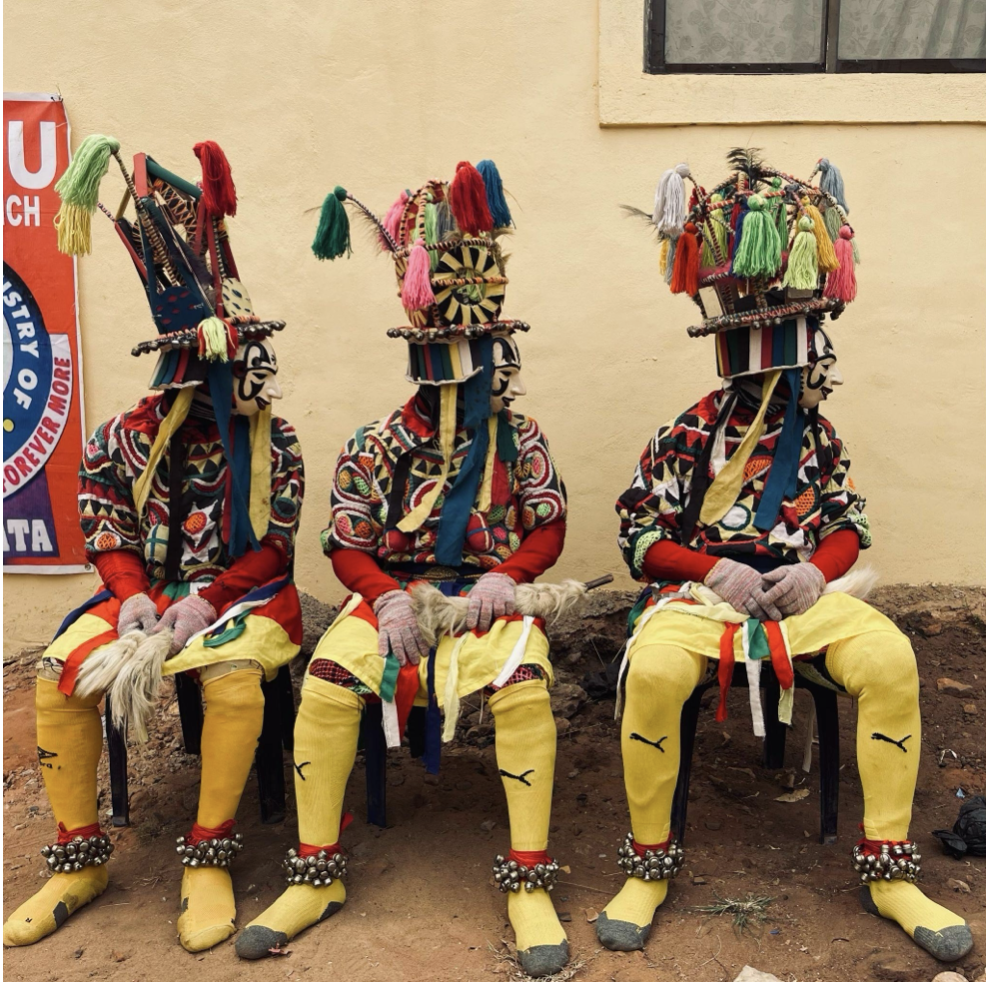
I saw his Ogolo paintings virtually. Then, I traveled to Onitsha, and I witnessed the Ogolo masquerades performed in person, and my admiration for his art deepened. It informed a deeper connection with Onitsha culture. It also touched on how art and life are interconnected.
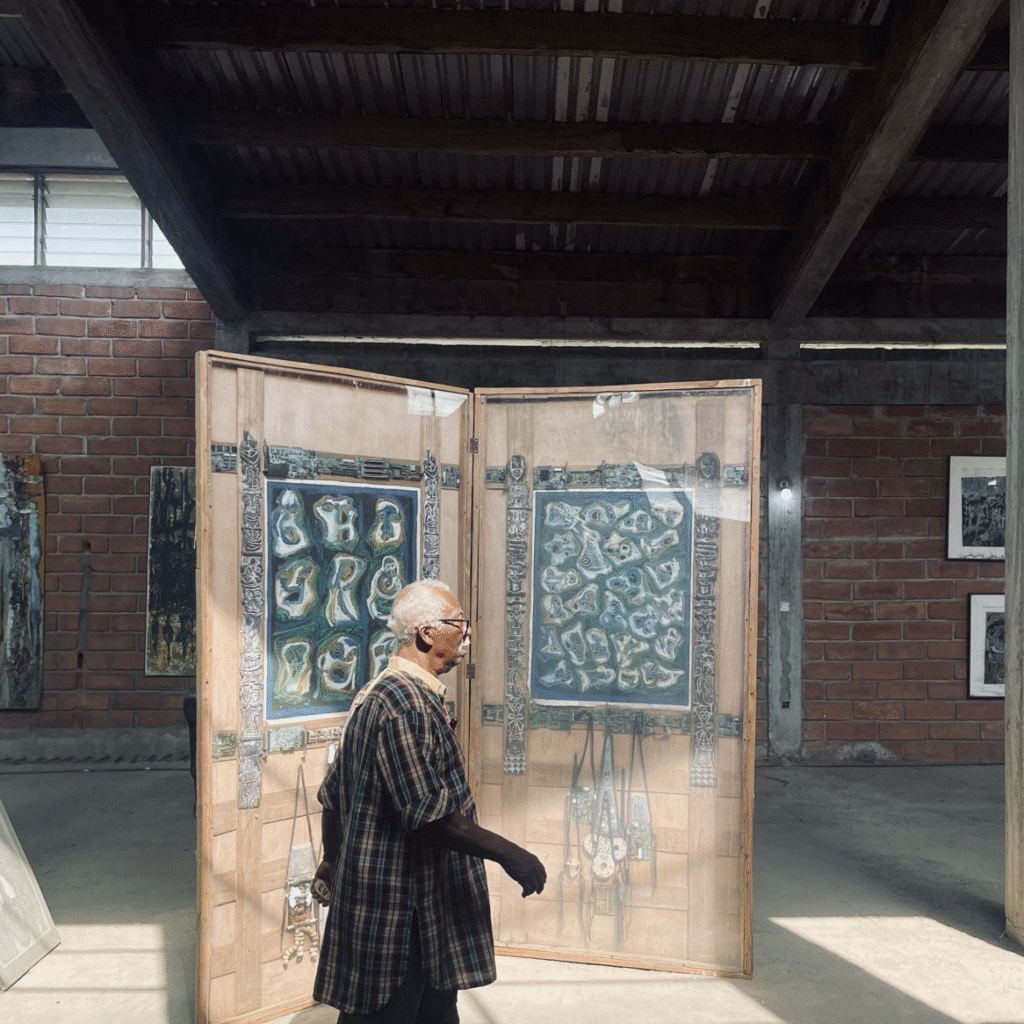
So, Anyanwu started by thinking through Ben Enwonwu’s practice and other artists like Uche Okeke, Yusuf Grillo, Bruce Onobrakpeya and members of the Zaria Art Rebels who actively practiced during his time. I was really inspired by how these artists, young people in a new Nigeria, created instrumental artworks in a time where their nation was transitioning into an independent, sovereign state.
It got me thinking about how they used their art to instill a sense of self and collective identity formation in society. Their art seemed to say, “we are all one, we are in this together.” I read Uche Okeke’s Art in Development: A Nigerian Perspective in 2024 when I started my research for the exhibition, and his manifesto really inspired me. My favorite line from this manifesto is “young artists in a new nation, that is who we are!” That was the starting point of Anyanwu.
I think of myself and my generation today; there is a war not too far from any of us, in Nigeria and beyond. Amidst this conflict, how can art speak to the times we live in and transform the darkness of our current times?
I think that was what the artists of the past did with their art, with Ben Enwonwu using Anyanwu to signify the rising of a new nation. I also thought about my ancestral lineage, including my surname, Agbapuonwu, which means to run away from death. I studied it through a transformative lens, and it led me down the path of Igbo cosmology.
In Igbo culture, we believe in reincarnation. When a person dies in Onitsha, we say onye ahu je ighote ife—that person went to the market, signifying a potential return. I also thought about what it would mean to stage an artistic intervention during a time when people engage with art pieces mostly through an aesthetic point-of-view, to observe instead and attune themselves to the energy of the pieces in view. Knitting these lines together led to Anyanwu: The New Light.
Anyanwu: The New Light is my way of reframing a personal narrative central to society. It is an exhibition of awakening and transformation. Beyond the visual art show, we have a book; an anthology of the Igbo worldview, the cultural matrix of the broader Nigerian cultural heritage and how our cultures are connected.
There is also a short film we shot across Onitsha and Lagos, where we interviewed “living ancestors” who are immersed in our indigenous knowledge systems, as there is a tendency for them to fade away with the predominant use of technology. This is also tied to the need to make people look beyond the Eurocentric worldview. Organized religion limits our access to a different realm and higher consciousness. Life is beyond what we can see and touch. All of these formed the sketchpad of Anyanwu.
RA: Are there any prominent Igbo figures you reached out to to ensure you used factual knowledge about indigenous knowledge systems?
TA: My team and I carried out meticulous scholarship and field research. I started by paying a courtesy visit to the Obi of Onitsha, His Royal Majesty, Nnaemeka Alfred Achebe. We introduced the project to him, and he was impressed by the idea. He took us to his Iba, a sanctuary/shrine for titled men in Onitsha. It was filled with royal symbols crafted by an artist, Emmah Mbanefo. He took me to the palace as well. This visit helped me forge a good relationship with Emmah Mbanefo, who was also exhibiting at the show. In Onitsha, I also connected with Chief Onoli Oguda of Onitsha.
Afterward, I went to Delta to visit Bruce Onobrakpeya in Agbarha-Otor, who turns 93 this year. I consider him a living legend. These are the people I like to call living ancestors. SUNY Professor Nkiru Nzegwu provided me with a lot of resources, as she has done extensive research on Ben Enwonwu and Onitsha.
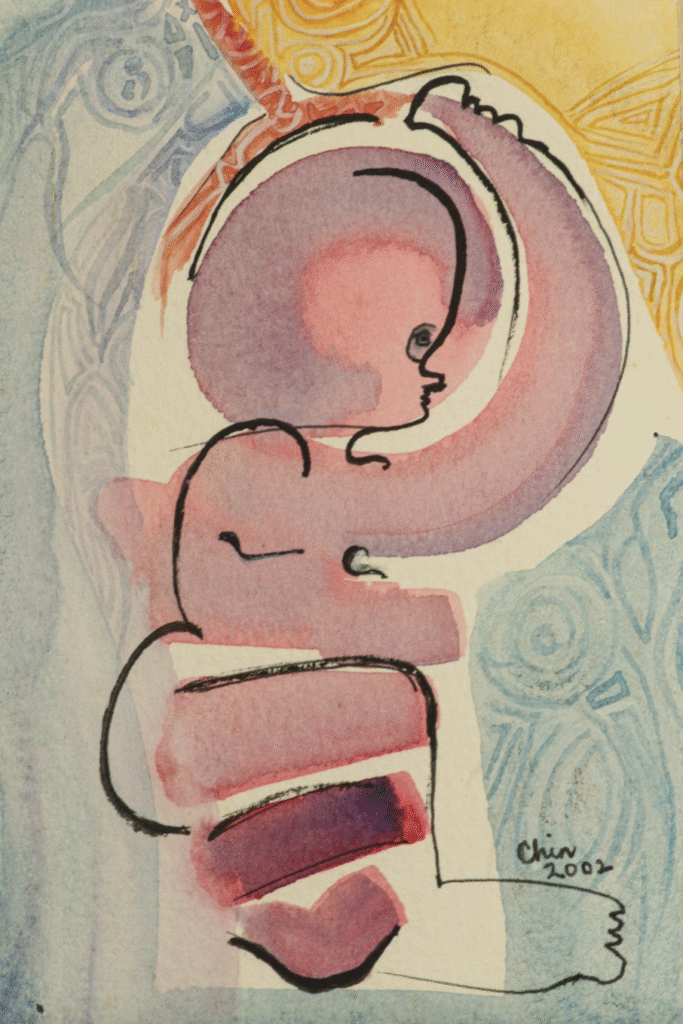
Conversations with the exhibiting artists were also very helpful. My conversations with Chinwe Uwatse felt like a masterclass. Studio visits with Obiageli Okigbo, phone calls with JC Bright and books by Emmanuel Iduma also provided more insight.
RA: Considering the major focus on Onitsha culture and Ben Enwonwu’s influence, does Anyanwu: The New Light only feature Igbo artists?
TA: I was not keen on artists with an Igbo background. Instead, I focused on those with interest in ancestral history, legacy and indigenous knowledge systems. This is also the theme connecting all the pieces on display, from uli to Onitsha ethnography, to masks and masquerades.
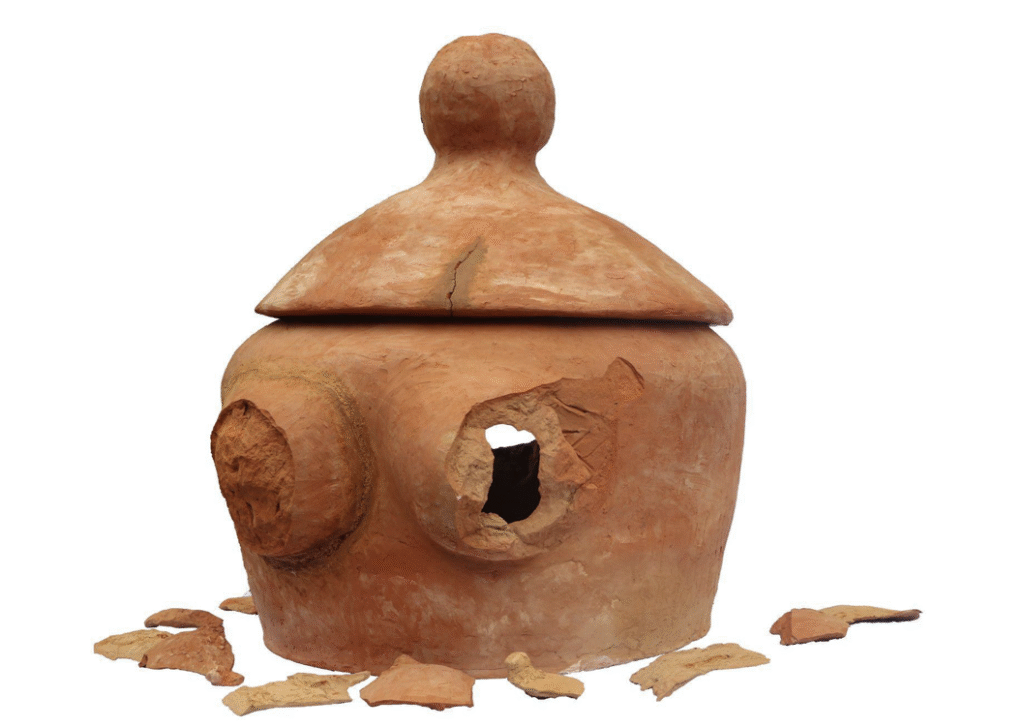
I particularly chose Mobolaji Otuyelu, a Yoruba artist who advocates for cooking with clay pots as a healthier food alternative. I approached her because I have an interest in food as an artistic practice.
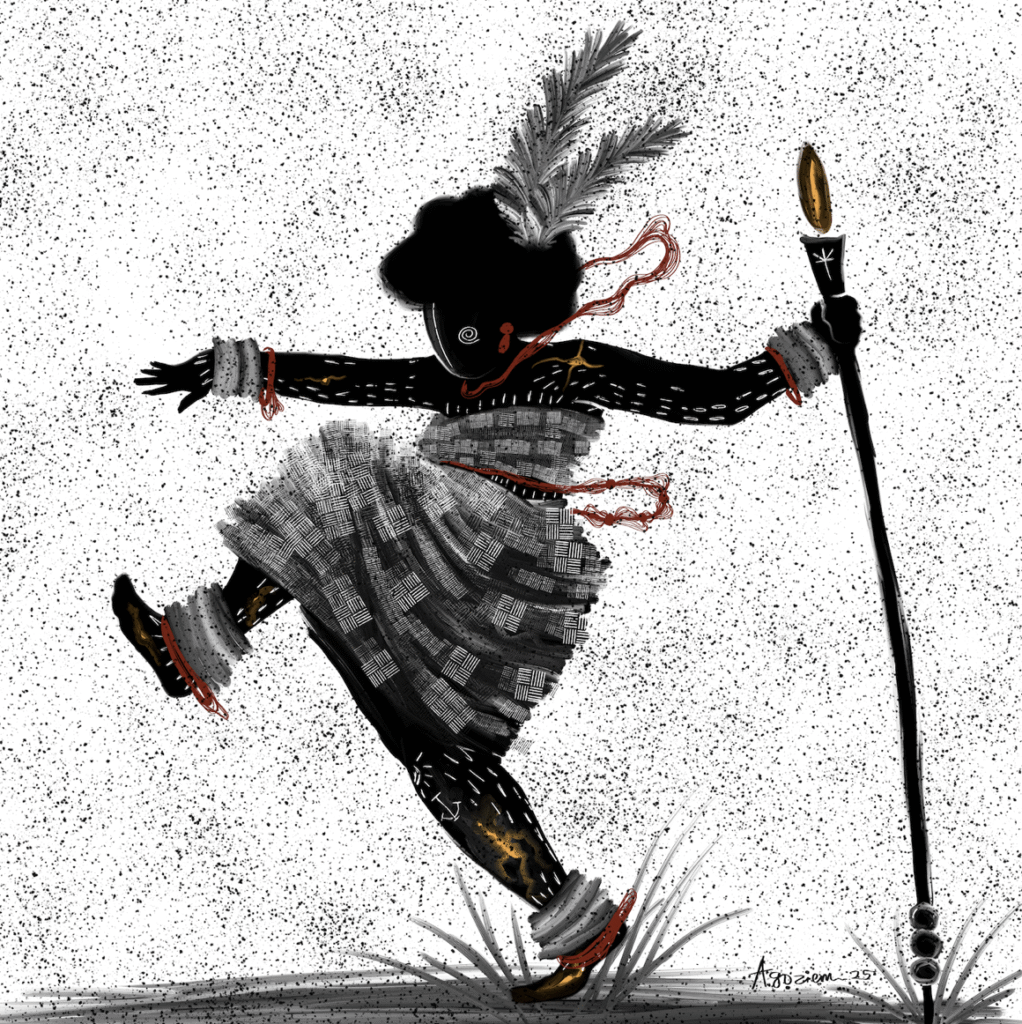
TA: I want the audience to experience a sense of pride in their cultural heritage. I want them to feel a sense of self, to feel connected with their roots and feel a sense of identity. I would like the older people in the audience to feel a sense of nostalgia, and I want the young people to get excited, because of the fresh perspective of the presented topics.
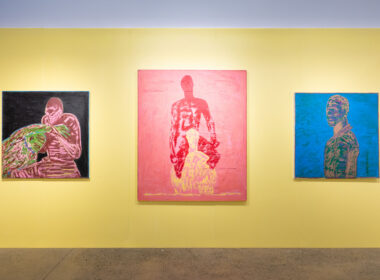
Anyanwu: The New Light will include the exhibition sketch pad; a collection of studio visits, Tony Agbapuonwu’s family archive, conducted interviews and the planning process of the exhibition in video and audio format.
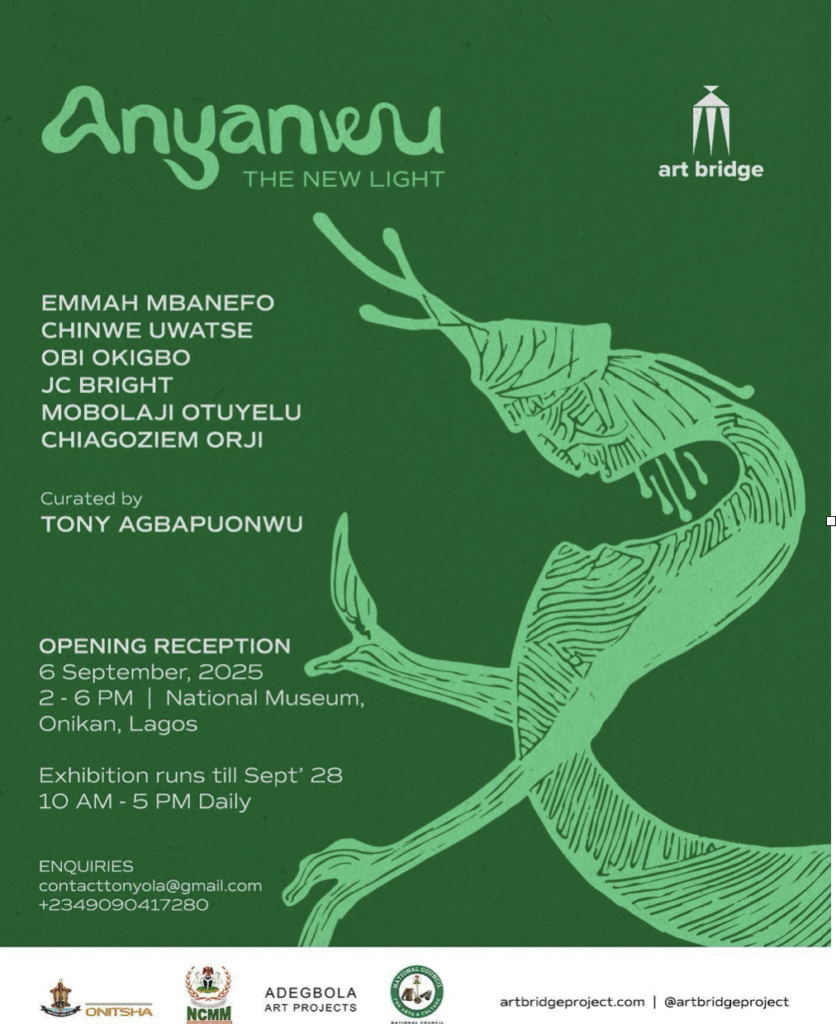
Anyanwu: The New Light is on display at the National Museum, Onikan, Lagos, from Sept. 6-28.