




This week, the question of who gets to shape, preserve, and reimagine Black cultural narratives takes many forms. In Cape Town, Zeitz MOCAA has turned to Elvira Dyangani Ose as it approaches its second decade, placing a curator with a distinctly Pan-African outlook at the helm of one of the continent’s most internationally visible museums. In Nairobi, a new architecture biennale is preparing to challenge the idea of Africa as a consumer rather than producer of spatial knowledge. Across the Atlantic, ten Black artists are complicating representations of Black masculinity in Baltimore, while the Joan Mitchell Foundation is betting on what artists can build when financial support is allowed to stretch across five years rather than disappear after a single grant. And in Atlanta, Whitney Houston’s unmistakable image has been transformed into a Barbie — a small object carrying an enormous cultural memory.
Elvira Dyangani Ose to Lead Zeitz MOCAA Into Its Next Decade
Zeitz MOCAA has appointed Elvira Dyangani Ose as its new Artistic Director, with the curator and museum leader taking up the position on 1 October 2026, just as the Cape Town institution approaches its tenth anniversary.
Dyangani Ose arrives with a career spanning the Tate Modern, The Showroom in London, the Göteborg Biennial and, most recently, the Museu d’Art Contemporani de Barcelona (MACBA), which she led from 2021. Born in Córdoba to a family from Equatorial Guinea, she has consistently examined public space, collective memory, and artistic practices beyond dominant Western frameworks.
At Zeitz MOCAA, she will oversee the museum’s artistic and curatorial direction across exhibitions, research, collections and public engagement, bringing an explicitly Pan-African perspective to an institution whose stated ambition has always been to connect Africa with the wider world.
Her appointment also carries the weight of succession. She follows Koyo Kouoh, whose leadership helped define the museum’s artistic identity and international profile before her death in May 2025.
For Dyangani Ose, the move represents both continuity and possibility: an opportunity to build on Zeitz MOCAA’s first decade while reconsidering how a major African museum serves artists, audiences and the histories it holds.
As the museum enters its second decade, the question is no longer how Africa is represented in the global museum landscape, but what an African museum can become on its own terms.
Joan Mitchell Foundation Awards $900,000 in Multi-Year Support to 15 Artists
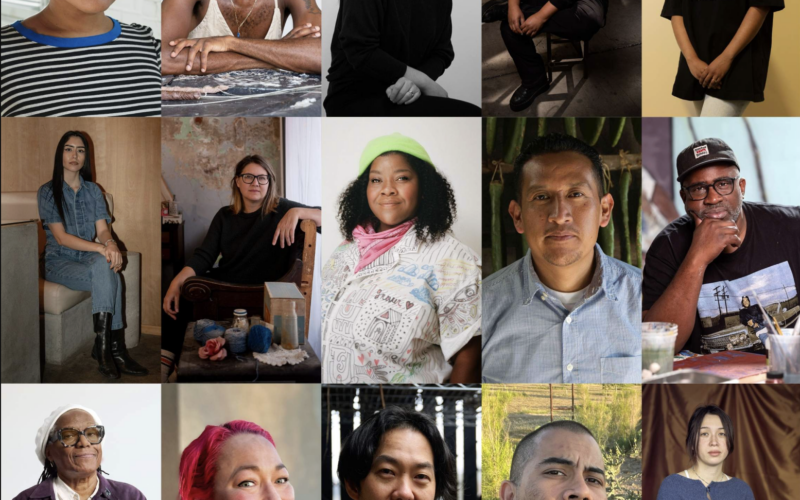
Fifteen US-based artists have been named 2026 Joan Mitchell Fellows, each receiving $60,000 in unrestricted funding distributed over five years, along with professional development, peer engagement, and networking opportunities.
The fellowship, established in 2021 as a rethinking of the foundation’s earlier Painters & Sculptors Grants, is designed around a simple proposition: meaningful support for artists cannot always be reduced to a one-time cheque. Instead, the program creates a five-year financial runway that allows artists to develop their practices with greater continuity.
For the Black artists in this year’s cohort, the fellowship comes at different points in their careers. Krista Clark, Cameron Clayborn, Roscoe Hall, Janet Olivia Henry, and vanessa german each work across distinct approaches to material, sculpture, and installation, reflecting the breadth of contemporary Black artistic practice in the United States.
Henry, 79, is the oldest artist in this year’s cohort. Her fellowship arrives at a moment when questions of artistic legacy become increasingly pressing. Rather than simply financing new work, the unrestricted award can support the less-visible infrastructure of a long career, including documentation, storage, bookkeeping, and planning for the future.
The program is particularly significant against a difficult funding landscape for artists and cultural organizations in the United States. The foundation has framed the multi-year model as a response to economic and political uncertainty and the instability facing arts funding.
Nairobi to Host Africa’s First Pan-African Architecture Biennale
This September, Nairobi will become the meeting point for a new continental conversation about architecture, urbanism and the built environment. The inaugural Pan-African Biennale will run from September 7–11, 2026 under the theme “Shifting the Center: From Fragility to Resilience”.
Conceived as a permanent Pan-African institution, the biennale seeks to challenge the position of Africa as a recipient of architectural knowledge rather than one of its principal producers. Its curatorial premise instead places African spatial intelligence, Indigenous knowledge and local design practices at the center of conversations about the continent’s future.
The program will bring together architects, designers, researchers, urban planners, policymakers, students and communities, with exhibitions, public panels, workshops, institutional dialogues and site-based encounters taking place across Nairobi.
That emphasis on Nairobi as more than a host city is central to the project. The organizers describe the city itself as an active curatorial site, with its architecture, institutions, public spaces and contemporary practices woven into the biennale.
At stake is a larger question: what happens when African cities are not treated as case studies for imported solutions, but as sites of knowledge capable of generating their own architectural futures? In September, Nairobi will begin testing that proposition.
Ten Artists Reframe Black Masculinity Through Art in Baltimore
What does Black masculinity look like when artists are allowed to define it for themselves?
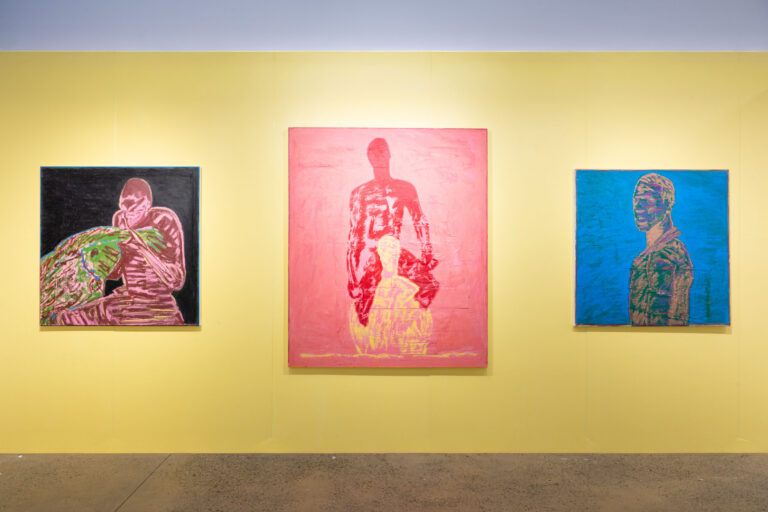
That question sits at the heart of 5 × 5 Baltimore: The Art of Black Men. This exhibition, at the Eubie Blake Cultural Center, brings together 10 Black male artists from Baltimore and Pennsylvania’s Lehigh Valley. The exhibition opened in June and remains on view through 22 August.
Featuring Ainsley Burrows, Al Johnson, Anthony Smith Jr., Charles Stonewall, Ernest Shaw, Femi J. Johnson, Jeffrey Kent, Jerry Prettyman, Larry Poncho Brown and Rigo Peralta, the exhibition brings together artists working across painting, photography, abstraction, mixed media and figurative practice.
The geographic pairing is deliberate. Baltimore and the Lehigh Valley share histories shaped by migration, labor, and Black community-building, while each has developed its own artistic languages and cultural histories.
Rather than offering another fixed portrait of Black men, the exhibition foregrounds multiplicity, vulnerability alongside resilience, memory alongside imagination, and personal experience alongside collective history. Organizers describe the gathering of ten Black male artists in a single exhibition as unusually rare.
The exhibition’s accompanying dialogue on Black art and identity extends that conversation beyond the gallery, asking how art can serve as a space for storytelling, healing, cultural memory, and self-determination.
At its best, 5 × 5 Baltimore is less a portrait of Black masculinity than an invitation to reconsider its possibilities.
The exhibition, which opened on August 1st, will be on view until August 22nd, 2026.
Whitney Houston Gets Her Barbie Moment
Whitney Houston has entered the Barbie universe, but the new collector’s doll does more than reproduce a famous outfit. It is turning one of the defining images of Black pop culture into an object of inheritance.
Unveiled on August 8th at the fifth annual Legacy of Love Gala in Atlanta, the Barbie recreates Houston’s look from her 1987 video for I Wanna Dance with Somebody (Who Loves Me) in the lavender dress, statement earrings, voluminous curls, and microphone stand.
The doll went on sale the following day, August 9th, which would have been Houston’s 63rd birthday. The project was reportedly more than two decades in the making, with an earlier concept considered around Houston’s role in The Bodyguard.
Its arrival comes during an especially significant year for Houston’s legacy. The singer received a posthumous Lifetime Achievement Award from the Recording Academy in 2026, while WH1TNEY, a collection bringing together her 11 Billboard Hot 100 number-one singles, was released around her birthday celebrations.
But the doll’s cultural resonance lies in the image it preserves: Houston at the height of her exuberance, before the icon became inseparable from the tragedy of her later life.
Here, Whitney is simply radiant — dancing, smiling and commanding the screen. And perhaps that is precisely the memory worth keeping.