




The Irene and Richard Frary Gallery situated at the Johns Hopkins University Bloomberg Center in Washington, D.C. is named after Irene and Richard Frary, key players on the Hopkins’ advisory board. The gallery is currently managed by Inaugural Director of the Irene and Richard Frary Gallery Caitlin Berry, and started hosting exhibitions in 2024.
As a public gallery with access to the university’s historical archives, it serves as the perfect spot to host Ceremony, displaying Lindsay Adams’ artworks alongside archival materials on African-American history, courtesy of the school’s Sheridan Libraries.
The Washington, D.C., area is home to multiple museums and galleries that support the expression of Black art and African American history. Adams, a D.C. area native, admits that this has influenced her as an artist. “Growing up surrounded by so much cultural memory shaped how I understand place, history, and belonging, and being raised in a region rooted in movement and activism deepened my interest in liberation and imagination.”

Adams became a full-time artist in 2022, though her personal journey as an artist began many years before then. She learned how to paint in high school. Encouraged by her teachers, she regularly participated in end-of-year exhibitions. She earned double degrees in International Studies and Spanish, with a minor in Studio Art, from the University of Richmond.
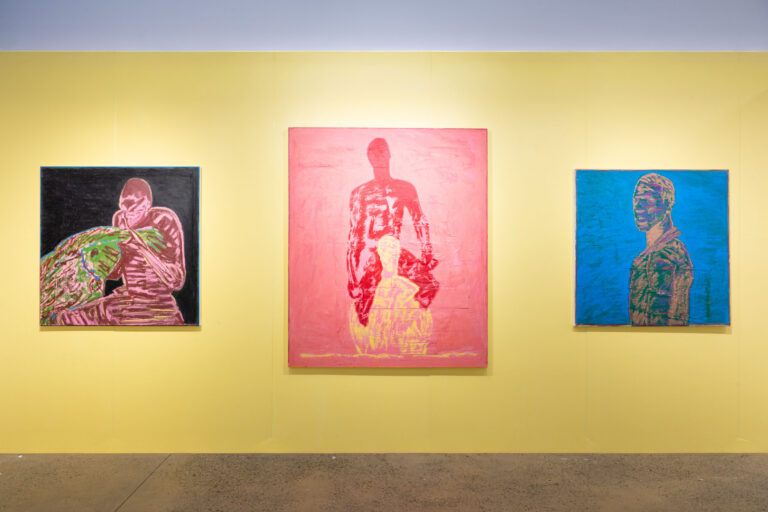
Adams’ visual art comprises painting and drawing. Her abstract/monochromatic drawings are done with charcoal, ink, pen, graphite, and cold wax. The vivid burst of colors seen in her work is achieved with oil paint and oil pastels. She favors painting above other art media, followed closely by photography.
Her artistic process is motivated by curiosity and the desire to explore ideas through color, gesture, and form. “Creating art allows me to move into spaces that language cannot always reach, and it gives me room to imagine and to push beyond what is familiar.”
While creating, Adams favors a well-lit work environment. “Spaces with bright natural light, room to read and research, and enough surface area to lay out my palettes and materials. When I have that sense of clarity and openness, the work is able to unfold naturally.”

During her undergraduate studies, she developed a keen interest in history and anthropology, which strongly influenced her artistic voice. Over time, her visual representations of Black ancestral connections to land and place flourished with the use of flora and human figures.
“As my work shifted toward abstraction,” Adams shared, “I realized that my interest in place was not only literal but psychological. My visual language grew. I became increasingly focused on imagination, expansion, and how far I could push color and line.”
“In recent years, I have worked in parallel with research, studying collective histories, spatial refusal, and liberatory practice. I have continued to push color, gesture, and form in order to build worlds,” she added.

She was introduced to the work of Black Washington artists Alma Thomas and Sam Gilliam of the Washington Color School during the early stages of her career, and it “opened my sense of what color, rhythm, and expansiveness could be, something that continues to move through my work.”
Thomas and Gilliam, along with Monet, Jack Whitten, Howardena Pindell, and Helen Frankenthaler, are major influences of Adams’ art. Their approaches to color, material, and experimentation have shaped how she thinks about abstraction.
She also draws inspiration from creatives outside the sphere of visual art. “I am guided by Black geographies, memory studies, and the historical research that grounds much of my practice. Literature is another major influence, especially writers who explore imagination, possibility, and the complexity of Black life. I also draw inspiration from the natural world, especially water and landscape, and from the quiet movements and gestures of everyday life that reveal how we inhabit place. All of these influences inform how I build color, line, and space in my work. Painting is also a form of meditation and release for me. It allows me to slow down, listen, and move through emotion and thought with intention, which keeps me connected to the core of my practice.”

Speaking about Ceremony, Adams notes that it creates space for her to honor the gray areas in African-American history and hold Black memory with care. “The exhibition allows history to surface through color, gesture, and the archival fragments that move quietly through the work. Abstraction offers me latitude to imagine beyond what has been prescribed and to shape new ways of seeing and being.”
“Ceremony asks viewers to slow down and pay attention to the stories that shape a place, and to consider how we carry those stories forward. In this way, the exhibition becomes both an offering and an act of insistence, a space for presence, possibility, and refusal of erasure.”

While Adams produced these stunning art pieces, Claudia Watts, the guest curator, ensured that the original copies of complementary archival history material from the Sheridan Libraries were displayed alongside them. Doing so provides visitors with an authentic viewing experience. These pieces were selected in accordance with Ceremony’s tripartite theme: travel (domestic and international), social mobility, and interiority and leisure, as experienced by the Black community.
Watts started organizing small shows for friends in D.C. around 2016, though she did not consider herself a curator. “I knew I was on my way but not ready to give myself that title,” she said. However, she worked at the Anacostia Community Museum, part of the Smithsonian, where she met several curators she admired. From the Anacostia, where she worked on the museum’s revitalization project for two years, she transitioned into marketing, special projects, and strategic partnerships.

Claudia M. Watts | 2025 | Photo by Kirth Bobb
Her career shifted in 2020, when she took on the role of Director of Culture at the Eaton Hotel in D.C. She met Adams at Eaton and curated her debut solo exhibition in 2022, titled Two Things Can Be True. They formed a close-knit friendship, with Watts describing Adams as “one of the most thoughtful human beings I know. Her work is rooted in deep research, and her studio practice is both rigorous and spiritual. She is empathetic and uses her intuition to excavate the nuances of life when others would rather skim the surface.” Watts’ remarks suggest that these qualities are reflected in her use of color and gesture.
“I curated several small exhibitions and worked with the arts community to present programs in addition to other hotel-related responsibilities. Since 2017, I have also maintained a writing practice and continue to work as a freelance writer. In 2022, I decided to go back to school to get my MA in Art History. I graduated in 2024 and started working at the National Gallery of Art as a research assistant,” she added.
According to Watts, Ceremony was inspired by two texts: Black Gathering: Art, Ecology, Ungiven Life by Sarah Jane Cervenak, and Sylvia Wynter’s essay The Ceremony Found: Towards the Autopoetic Turn/Overturn, Its Autonomy of Human Agency and Extraterritoriality of (Self-)Cognition, from which the title “Ceremony” was borrowed.
“In Cervenak’s text, she uses various artworks and literary examples. Her framework seeks to dispel enlightenment ideologies that consign African American existence to perpetual ownership or an assumed givenness. Gathering, physically and conceptually, becomes an act not only of survival but of cultural preservation meant to withstand imposed forms of erasure. Essential to the reading are the ways in which community, in its many facets, can facilitate life beyond the superstructures that inflict violence upon the other.”
“In this sense, Ceremony is a fragmented collection of stories in which Adams’ canvases represent the gathering of ideas, moments, values, and desires. The archival materials are both symbols of the concepts with which Adams engages and remnants of real lives. Together they celebrate and illuminate the ways African Americans have navigated their surroundings in an effort to cultivate spaces of safety, creativity, respite, and economic access.”

“Together,” says Watts, these stories, represented through archival objects and expressed with Adams’ painterly technique, demonstrate alternatives to a circumscribed identity and quality of life. They point toward a nascent consciousness of the intrinsic value we possess as people, despite any worldly restrictions or categorizations. It is in this spirit that we chose to invoke Sylvia Wynter’s essay The Ceremony Found: Towards the Autopoetic Turn/Overturn, Its Autonomy of Human Agency and Extraterritoriality of (Self-)Cognition.”
“In this text, her words speak to the power of narrative and remind us that if certain mythologies exist to tell the world who we are, they also exist to keep us trapped within the status quo. For Wynter, the ceremony is where we find freedom by recognizing the many modes of human existence, bringing them into a nonhierarchical relation with one another, and remaking ourselves in that image. Our Ceremony offers entry into this line of thinking, the ideas and experiences presented are a testament to the transformative power of community,” she further explained.
All the pieces exhibited at Ceremony are interconnected, embodying a multifaceted activist narrative of the Black experience, from entertainment and travel to interpersonal experiences. Watts provides illustrations based on the exhibited pieces to buttress this point. “When we think about Langston Hughes’ autobiography The Big Sea, he is traveling to find greater opportunity than what has been allowed in the United States.”
“Another example is the impact the automobile had on Black life,” directing viewers to a studio portrait of a family posing in a car, as a fitting example. “It afforded greater opportunities for interpersonal connectivity and space for other community-driven innovations because people could see their friends and family more often without the perils associated with walking down a dark back road, crossing through an unwelcoming neighborhood, riding on a dirty car, or being humiliated in a myriad of ways while on public transportation. Through abstraction, Lindsay’s work acknowledges this past while inviting people to reimagine the world around them.”
Watts selected the exhibited pieces after conversing with Adams about her creative process. Drawing on her personal observations of the artist’s studio practice, she developed a unifying theme that formed the basis of the show. She carried out subsequent research in the Sheridan Libraries Special Collection and was able to gather the necessary historical materials paired with Adams’ works.
Based on her findings and eventual curation, the curator identified the show’s themes as movement and mobility, and their impact on the behavior of African Americans throughout history, with their refusal to accept allotted spaces, and crafting new spaces to dwell in. “Lindsay’s paintings embody this ethos while the archival objects represent these themes in the real lives of people, both those who were well known and those who remain unknown.”

Kind of Blue (1959), named after African-American jazz artist Miles Davis, reflects Adams’ reverence for music with Black origins, for which she often names her paintings. She also seeks to embody the Black expatriate experience during the Jim Crow era. Solar Searching, a brilliant combination of reds, greens, and yellows, is paired with Billie Holiday’s travel itinerary and some postcards. Errantry/Exodus is reminiscent of the green ink Langston Hughes used for his signature, and serves as a response to his debut autobiographical novel, The Big Sea. Lotus Blossom (1968), named after Billy Strayhorn’s composition, which gained popularity after Duke Ellington’s performance, is paired with ephemera from some influential Black organizations, like the Improved Benevolent and Protective Order of the Elks of the World. Where can I go to frolic? a set of paintings noticeably smaller than other paintings resonates with the theme of leisure, a concept that was alienated from the Black experience during the Jim Crow era. These paintings, evocative of longing, are paired with postcards that allude to the same fact. Some paintings, deliberately left untitled and named as such, encourage individuality among viewers. Pictures of Adams’ notes, framed and placed alongside these pieces, invite gallery visitors to view the world as she does.
So far, Adams’ latest exhibition has garnered significant recognition since its opening at the Hopkins Bloomberg Center from the D.C. art community. The archival materials, postcards, and telegrams were also made to create an interactive experience for visitors. The exhibition’s playlist, curated by Sean Jones, the Richard and Elizabeth Case Chair in Jazz Studies at the Peabody Institute of The Johns Hopkins University , consists of music from artists referenced in the exhibition, like Billie Holiday and Miles Davis, among others.
Ceremony will be on display at the Irene and Richard Frary Gallery until March 7, 2026.