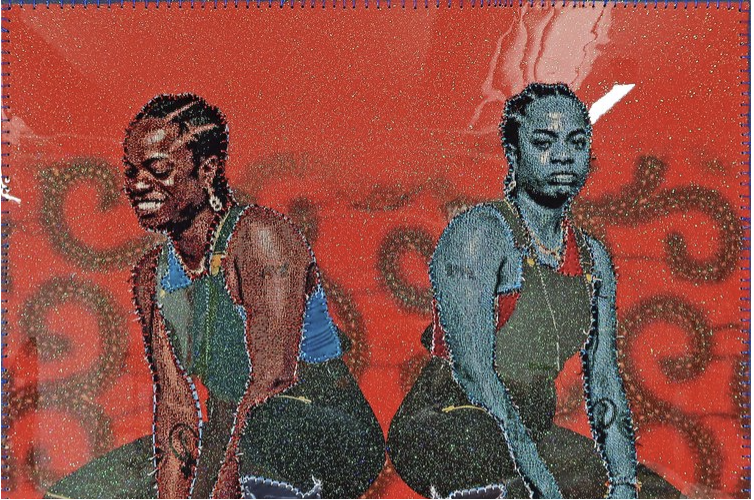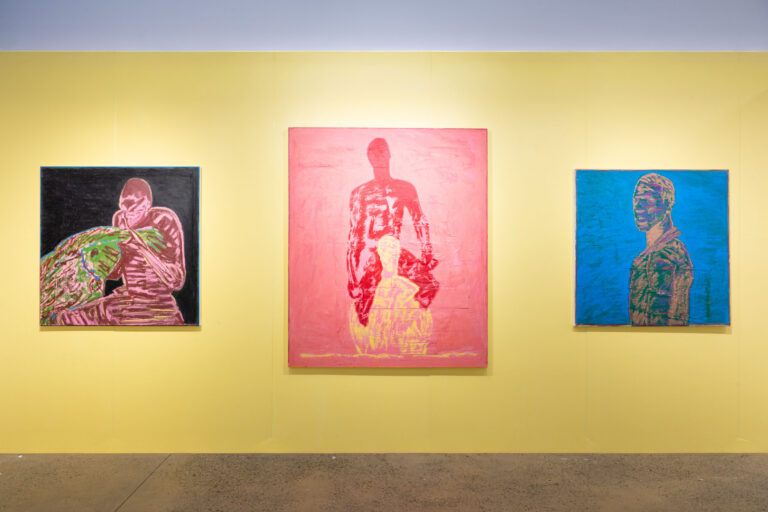






The Centro Andaluz de Arte Contemporáneo (CAAC) in Seville presents Améfrica: Diasporic Connections in the Jorge M. Pérez Collection (Améfrica), an exhibition curated by Brazilian curator and scholar Helio Menezes and drawn from the holdings of the Jorge M. Pérez Collection and El Espacio 23 in Miami. The presentation brings together 128 works by 99 artists and examines the global influence of the African diaspora across generations and geographies.
Housed in a 15th-century Carthusian monastery on the banks of the Guadalquivir River, CAAC is one of southern Europe’s leading contemporary art institutions. On view in the museum’s North and East Cloisters through January 10, 2027, the exhibition opens CAAC’s 2026 program with a project that deepens cultural dialogue across both sides of the Atlantic.
AFRICAN FOUNDATIONS
Through 128 works organized across five chapters, the exhibition offers a renewed reading of Africa’s imprint on the formation of the Americas, approached through relational, political, and aesthetic lenses. Spanning painting, sculpture, photography, installation, and textile practices, the presentation includes artists born in more than thirty countries across Africa, the Americas, Europe, and Australia, reflecting the global dimension of the African diaspora and its enduring impact on contemporary culture.
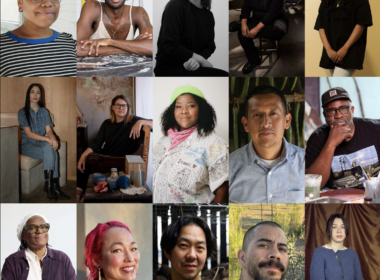
Featured artists include internationally recognized figures such as Kara Walker, María Magdalena Campos-Pons, Wifredo Lam, Rubem Valentim, Igshaan Adams, Zanele Muholi, El Anatsui, and Esther Mahlangu, the most senior artist in the exhibition at age 91. The presentation also establishes a dialogue between pioneers such as Rubem Valentim, Bertina Lopes, and Mahlangu and later generations including Nnenna Okore, Ayan Farah, and Kapwani Kiwanga, whose practices echo related references across distinct historical moments.
“As a collector, I am interested in supporting works that expand our understanding of history and challenge simplified narratives,” says Pérez. “Améfrica underscores that we share intertwined origins and that no artistic expression, nor any society, emerges in isolation. We are the result of crossings, trajectories, and shared memories.”
CONCEPTUAL AXES
The exhibition unfolds across five thematic chapters inspired by ideas that Lélia Gonzalez identified as central to processes of africanidade. Together, they frame the works through historical, political, and symbolic perspectives.
Adaptation
This section examines both forced and voluntary crossings that shaped relationships between Africa and the Americas. The works evoke transatlantic and overland journeys, the movement of goods and people, and territories reimagined as Amefrican landscapes. Artists including El Anatsui, Ibrahim Mahama, María Magdalena Campos-Pons, and Juan Carlos Alom reflect on migration, material circulation, and memory across geographies. Several works suggest that cultural continuity often transcends national borders.
Resistance
Here, artists engage the visual languages of resistance and contemporary activism. As curator Helio Menezes notes, the works translate the socio-racial tensions of the present into material and formal expression. Particular attention is given to the figure of the Black mother, evoking resistance through care, protection, and struggles against racism and xenophobia. Artists in this section include Mickalene Thomas, Bisa Butler, and Zanele Muholi.
Reinterpretation
This chapter explores how spiritual and religious traditions have been reshaped through displacement and survival. The works move beyond conventional iconography, drawing on ancestral presences, ritual practices, and trance as sites of knowledge and power. Artists such as Manuel Mendive Hoyos, Belkis Ayón, Frida Orupabo, and Turiya Magadlela engage inherited spiritual frameworks while reconfiguring them for contemporary contexts.
Creation of New Forms
Focusing on experimentation and innovation, this section highlights the development of hybrid visual languages. Artists including Stanley Whitney, Sam Gilliam, Serge Attukwei Clottey, Sonia Gomes, and Kapwani Kiwanga work across chromatic abstraction, sculpture, and textile structures, mobilizing mineral materials, organic fibers, and repurposed objects to construct new aesthetic vocabularies.
Amefricanas
The final chapter centers on self-representation by Black women artists who construct new visual imaginaries in the first person. Through painting, sculpture, photography, and installation, these artists move beyond colonial stereotypes and propose new narratives of the body, gesture, desire, and image. Featured artists include Kara Walker, Carrie Mae Weems, Lorna Simpson, Nandipha Mntambo, and Faith Ringgold.
The Jorge M. Pérez Collection and El Espacio 23
The Jorge M. Pérez Collection is a Miami-based private collection dedicated primarily to contemporary art, with significant holdings of African and African diaspora art, Latin American art and its diasporas, as well as works from the United States and selected European contexts.
Over the years, the Pérez Collection has developed sustained relationships with leading international institutions, advancing loans, curatorial collaborations, and traveling exhibitions with major museums including the Museo Nacional Centro de Arte Reina Sofía in Madrid, Tate in London, and the Pérez Art Museum Miami, among many others.
The collection is activated through El Espacio 23, a nonprofit art space founded by collector and philanthropist Jorge M. Pérez and his wife Darlene Pérez. Located in a renovated 28,000-square-foot former industrial warehouse in Miami’s Allapattah neighborhood, El Espacio 23 is open to the public free of charge and presents exhibitions, residencies, educational initiatives, and special projects drawn from the Pérez Collection in ongoing dialogue with international institutions and artistic communities.