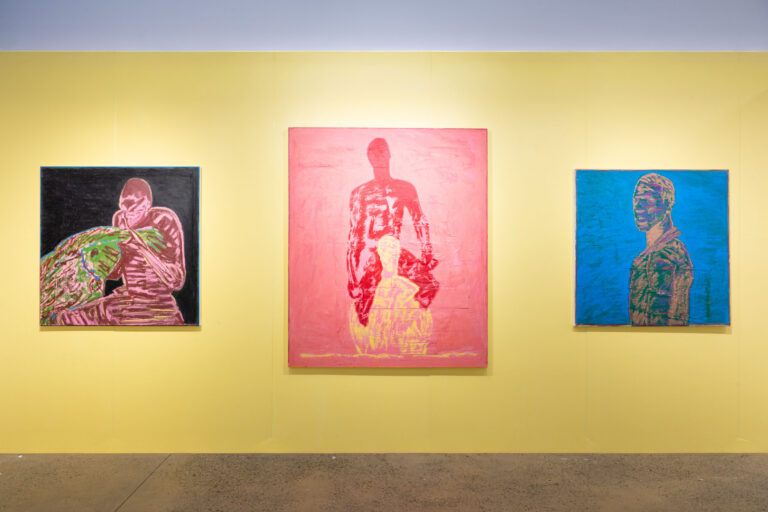




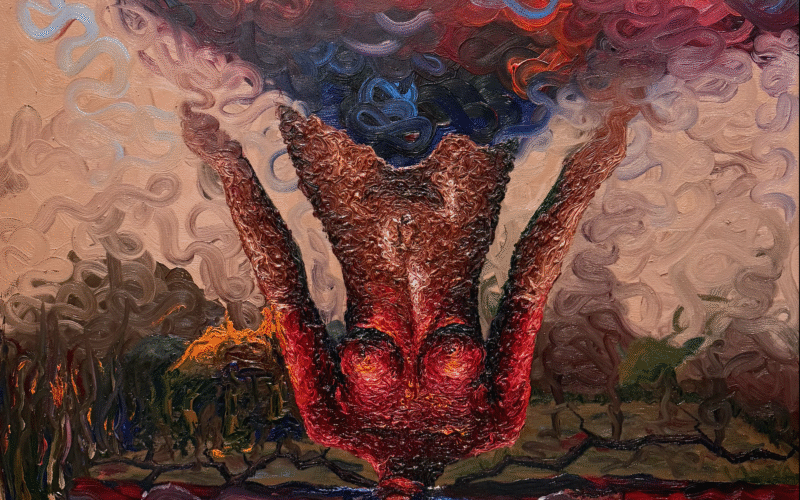
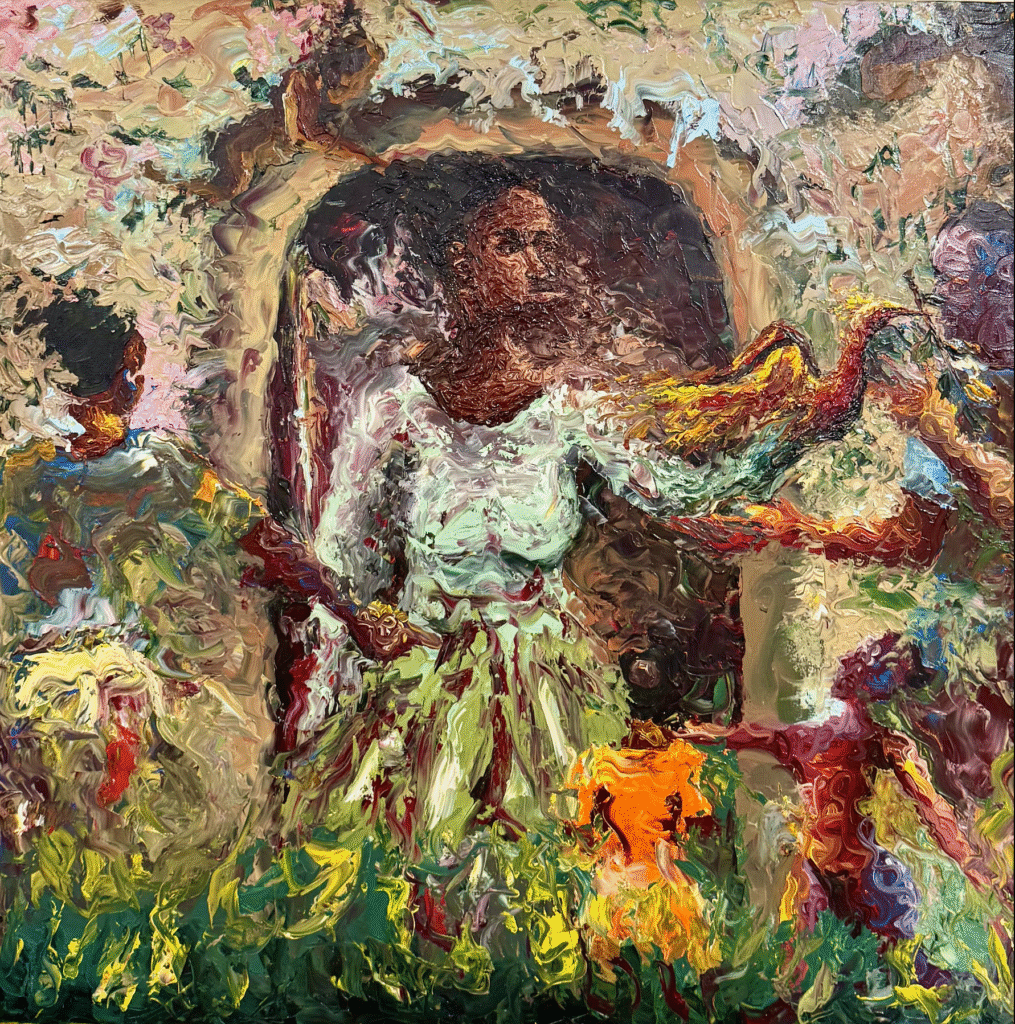
Above: Chidimma Urunwa Ikegwuonu |The Inversion of Apophasis, 2025 | Oil on canvas
At the heart of Chidimma Urunwa Ikegwuonu’s work lies a peculiar stillness—quiet yet never passive. Her paintings do not demand attention with noise; instead, they gather, and they invite. They ask something of the viewer, to not just look, but to understand.
Over the years, she has emerged as one of the most thoughtful and compelling voices in contemporary painting. To simply call her a visual artist leaves too much unsaid. Her practice weaves memory, metaphor, material and culture into forms that hold both tenderness and tension.
Ikegwuonu is a Nigerian painter whose practice is rooted in questions of femininity, womanhood, culture, memory and health. Now based in Manchester, U.K., she works with oil on canvas to create paintings that draw from both the intimate and the collective, weaving lived experience with broader cultural memory. In recent years, her work has gained even more attention through recent 2025 exhibitions such as Ode to Becoming (two tales, one body) and The Weight of Dream, where she presented paintings that probed the cycles of growth and renewal in nature and womanhood. Through these works, she interrogates how society defines femininity and where women might locate themselves outside those confines.
At the heart of her practice is a sensitivity to the ways personal and collective experiences intersect. She has spoken about how her paintings are shaped not only by what she has lived but also by what she has witnessed, studied and exchanged in conversations with others. These themes are not abstracted from her daily life but are extensions of it. Her paintings emerge as visual meditations on questions that concern both the body and the spirit and on how culture and history leave their traces on women’s lives.
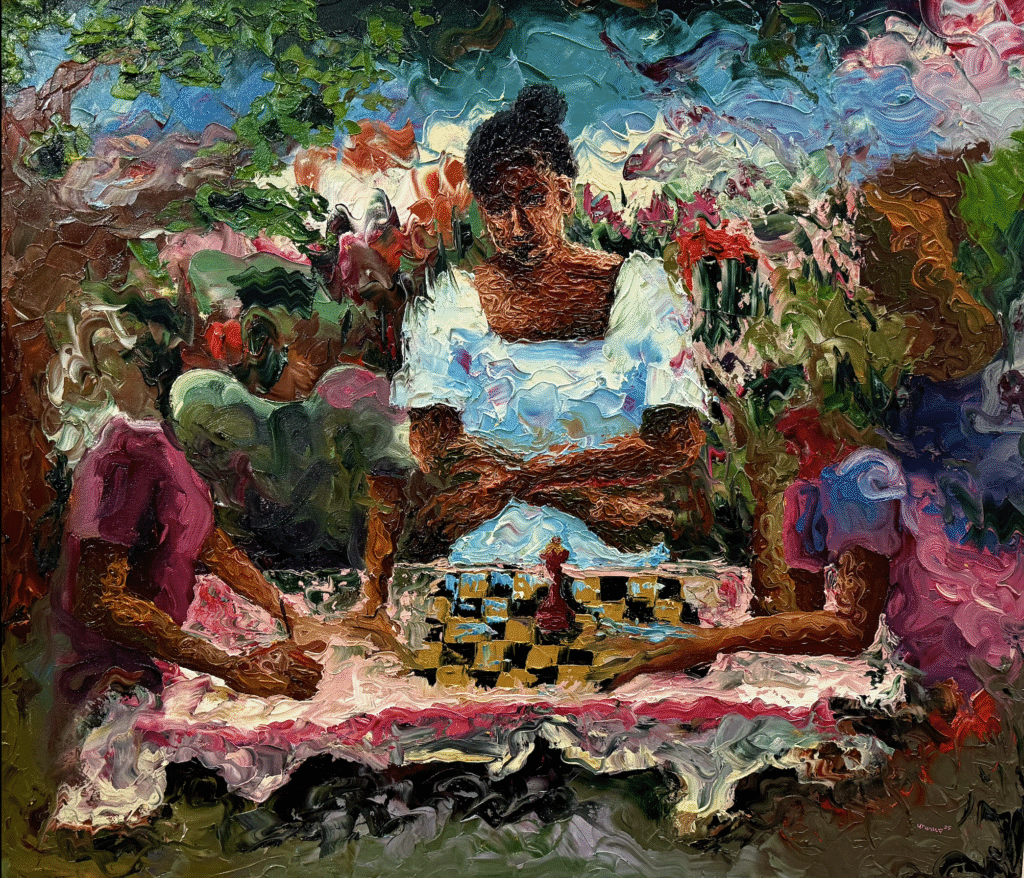
Her recent exhibitions have been important markers of her evolving practice. In Ode to Becoming (two tales, one body), Ikegwuonu explored parallels between nature and womanhood, mapping cycles of growth, reproduction, renewal and survival. The paintings in that body of work offered lyrical reflections on how women, like trees or rivers, navigate seasons of flourishing and seasons of depletion.
By placing womanhood in dialogue with natural rhythms, she raised questions about resilience and the possibility of regeneration outside of society’s rigid expectations of femininity. The Weight of Dream, which was presented shortly after, extended these inquiries. Here, she continued to paint with a concern for the intangible burdens and desires carried by women. The works traced how femininity is often imagined, defined and constrained by society but also how women continue to find ways to slip beyond those strictures, even in subtle acts of renewal and resistance.
This commitment to interrogating gender and health is not accidental. For the artist, these issues are part of her everyday reality. In her words, “Gender issues are things many of us have lived through, and they leave marks in ways we often carry silently.” Her practice becomes a way to speak of these marks and insist they matter. During her postgraduate research on dysmenorrhea, she realized how little attention is given to women’s health in research and policy. That discovery sharpened her artistic purpose.
Through her paintings, she brings visibility to these neglected realities, creating forms through which they can be acknowledged, reflected on and discussed. The body, in her work, is never neutral. It is always situated, marked by history and shaped by inequalities that become visible through illness, silence or neglect.
Her latest works signal an even more daring turn in her practice. The Inversion of Apophasis (2025) presents a striking play of concealment and revelation. The title points to a rhetorical device in which something is mentioned by denying its mention, and Ikegwuonu’s painting seems to translate this idea into visual form. Figures emerge and recede, simultaneously present and withheld, creating a sense of tension between what can be said and what remains unspeakable. The painting suggests that femininity itself is often described through absence, through what society insists it is not, rather than through what it is. To invert this logic, as she does, is to claim space for women to define themselves on their own terms.
In Arms, another 2025 work rendered in oil on canvas, she returns to one of her recurring motifs: hands and limbs. Hands in her visual language signify labor, care and connection. In this piece, they become entangled, reaching toward each other in gestures that oscillate between embrace and struggle. The work raises questions about solidarity, the burdens women carry and the strength found in collective gestures of care. She has often spoken about how these symbols connect the personal and the communal, how a single hand might signify both an individual’s tenderness and a community’s resilience.
Imughari Ozo (2025), which translates to “to begin again,” is another striking one. It is an exploration of renewal, of cycles that return not in repetition but in transformation. The painting is steeped in Igbo cultural references, reflecting how Ikegwuonu draws from memory and collective heritage to construct visual forms. Leaves, trees and natural elements recur, grounding the work in images of resilience and rootedness. In connecting these symbols to cycles of womanhood, she gestures to the possibility of starting anew, of survival as a continuous act of becoming.
Symbols are central to her paintings. Hands, as mentioned, are recurrent. Birds, too, appear across her canvases, standing in for freedom and migration while trees and leaves ground her imagery in ideas of growth and endurance. These symbols serve as anchors, recurring enough to form a recognizable lexicon yet open enough to allow multiple readings. They carry personal significance for the artist but also resonate with viewers who can attach their own stories to them. In this way, her paintings bridge the deeply intimate and the widely shared, inviting audiences into conversations that move between individual and collective experience.
Her approach to memory further deepens this duality. She often draws from her personal stories, but she is keenly aware her story is part of something larger. Memory, in her work, is both private and collective. This perspective shapes how she uses symbols and images, allowing her paintings to feel both close and expansive. They resonate as personal testaments yet simultaneously function as cultural documents, gesturing to histories, rituals and practices that extend beyond the self.
Within the Nigerian and broader African art scene, Chidimma Urunwa Ikegwuonu positions her work as a challenge to patriarchy. By centering women’s experiences, she adds to the ongoing project of making visible voices that have often been ignored. Her art is not only about aesthetics but also about urgency. It insists on conversation, particularly around women’s health, gender and cultural expectations. In doing so, she joins a growing number of contemporary African artists who are pushing against silence and claiming space for narratives that resist marginalization.
What makes these works particularly compelling is the way they merge the poetic with the political. Her canvases are visually lyrical, filled with layered imagery, yet they are also insistently grounded in lived experience. She is attentive to form and color—the red hues and surrealism bring to mind the works of one of Nigeria’s modernists, Obiora Udechukwu. She pays attention to the painterly craft, while remaining guided by the social realities she inhabits. The result is work that does not separate beauty from urgency but instead holds them together.
Her trajectory suggests an artist constantly evolving, not only refining her visual language while expanding the depth of her inquiries. From Ode to Becoming and The Weight of Dream to her more recent works, we see an ongoing movement toward complexity and daring. Her exploration of apophasis, for instance, shows a willingness to engage with abstraction and philosophical ideas, while still tethering them to urgent social concerns. This balance between intellectual exploration and visceral storytelling is what gives her work its richness.
Chidimma Urunwa Ikegwuonu’s practice is an unfolding journey, one that continues to grow in confidence and range. Her paintings remind us that art can be both a mirror and a provocation, reflecting lived realities while pushing us to imagine differently. Through her work, she asks what it means to inhabit womanhood beyond societal confines, what it means to carry memory in the body and how we might begin again, always in cycles of becoming. Her paintings remain faithful to the intimate while opening themselves to the collective, offering images that are at once deeply personal, resonating with the experiences of many others, not just in Africa but around the world.