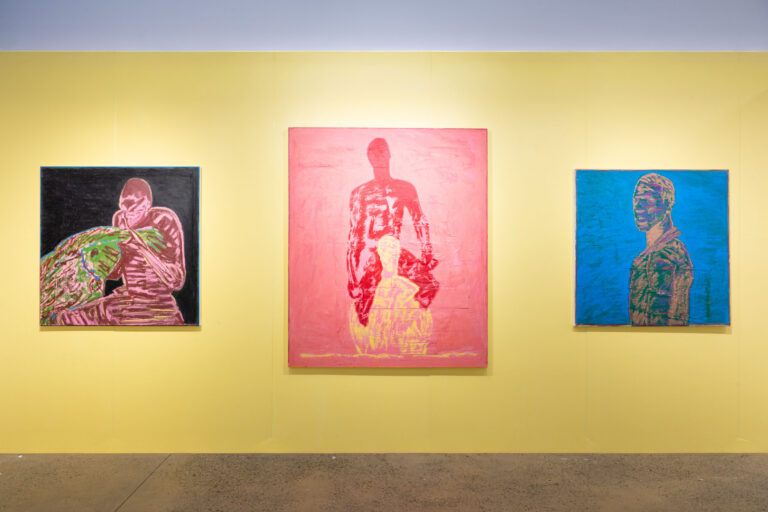




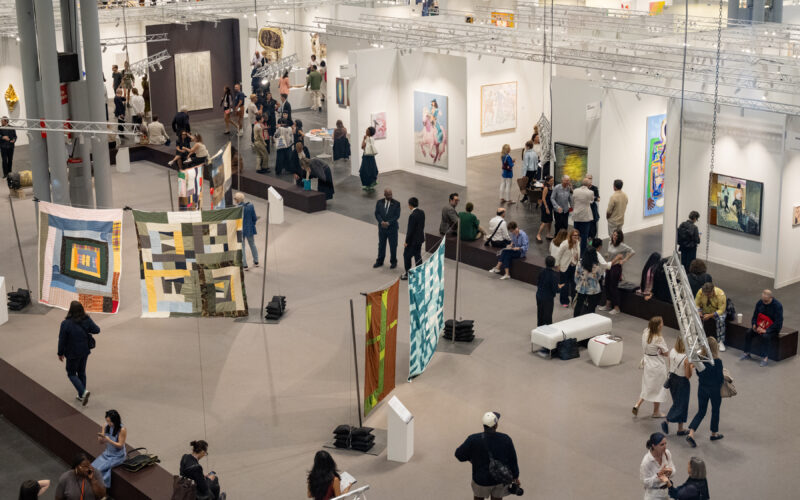
Above: Photo by Casey Kelbaugh. Courtesy of The Armory Show and CKA.
Quilting took center stage at the 2025 Armory Show (Sept. 5-7). Near the VIP Cafe in the Javits Center, standing quilts from Gee’s Bend, Alabama, blanketed the open space. The blank, white gallery walls of the Armory Show gazed at quilts crafted by Southern Black women artisans. Patterned and multicolored shapes layered each quilt. One artisan, Mary Margaret Pettway, sat among them with Raina Lampkins-Fielder, curator of Souls Grown Deep and the Armory Show’s Platform section.
“It was really important for me to highlight a small selection of creativity in a big space,” Lampkins-Fielder said, “to give not just a sampling of the incredible work done in the South, but by Black artists, and mine a little bit into the materiality of their work.”
Pettway’s hair was gray with experience, her eyes were quiet, and her hands, still while listening, moved gracefully when she spoke. Pettway quilts to keep her family’s tradition alive, which continues to thrive after more than four generations. She mentioned reverence for her mother, who taught her, and her grandmother, who taught her mother, while her daughter nodded and affirmed their lineage.
In America, quilting is a practice grown from the soil. In Gee’s Bend, the practice was nurtured by 1930s-era government support, which empowered residents to own the land on which their ancestors were once sharecroppers. Black women quilters from Gee’s Bend and Alabama communities revived national appreciation for quilting in the 1960s by founding the Freedom Quilting Bee, which produced made-to-order quilts for Sears, Bloomingdale’s and other retail contracts.
Quilting has budded among Native and African American artisans alike. Quilting greats like Agatha P. Bennett, Nancy Ethel Adair, Mary Lee Bendolph and Loretta Pettway showcase how different regions, generations and people wear quilting as a cultural practice.
This tactile medium demands an intimacy of felt knowledge. Quilting isn’t a practice that can be understood without experiencing it firsthand. In a conversation at the Armory Show, Pettway made a connection between traditional media like quilting and living with nature.
“I take what I know for granted,” Pettway said with a smirk. “If you’ve never seen a forest, a true forest, right? And I’ve lived there; I don’t even see a forest. I see trees.”
Appreciating textile work drives at the layered mystique behind its development. The value of quiltmaking lies more in its process than in the surface layer of its aesthetics. The process of quiltmaking differs from other artforms in the closeness that materials and procedures have with their creator.
Quilts have international relevance as stitching is culturally specific. Thanks to organizations like Souls Grown Deep, quilts from Gee’s Bend and the American South reside in about 40 museums on three continents.
Modern quilting practices took generations to develop, and learning the practice takes years. It relies on found materials that are unique to a quilter’s environment. A complete quilt can mix multiple stitches, fabrics and borders, and these choices showcase distinctive significances, which sometimes have undefined sources.
For example, quilts from Gee’s Bend show abstract shape patterns and use improvisational approaches to complete quilts. According to Souls Grown Deep, the improvisational or “my way” quiltmaking extends into the materials, often recycled materials like old clothes and used sacks, among other recycled garment materials.
It continues a multicultural legacy dating back to before chattel slavery. Central and West African weaving practices are the deepest roots that connect to African Americans’ quilting practice, according to the African American Registry. In relation to African Americans, quilting was used uniquely for coded storytelling during enslavement. Quilting is elevated in African American culture in connection to slavery; yet quilting’s significance is most profound in its continued lineage and unity across cultural traditions.
“It’s been a tradition that hasn’t stopped,” Lampkins-Fielder said. “That’s one of the reasons it’s so unique. It’s been a continuous tradition of passing down these very particular skills.”
Quilting is a tradition that’s stitched in time across cultures, but it’s also becoming a target for recent government funding cuts. In April 2025, the Department of Government Efficiency (DOGE) cut grant funding to the National Endowment for the Humanities and the Institute of Museum and Library Services. These funding cuts indirectly target the Quilt Index, a digital quilting history bank and resource hub.
Despite its high potential for sale and growing attention from the art world, Pettway believes quilts are priceless. Their hereditary lifeblood represents the value of time invested in making them, multiplied by the experience gained through the passing down of knowledge by hand. Quilting is a priceless art form because of the tradition it passes down from people whose records may have been lost or erased.