

Every year, the Centre for Memories (CFM) holds the Things Fall Apart Festival in Enugu, Nigeria. This event commemorates the novel Things Fall Apart and the life’s work of literary icon Chinua Achebe. Since 2020, the Centre has carried this out religiously with diverse, unique themes drawn from the novel.
This year, the TFA Festival was set up as a week-long event to celebrate the 67th anniversary of the publication of Things Fall Apart. Its theme, “Masculine, Feminine, Human: The Dialogue of Complements in Things Fall Apart,” set the tone for the art exhibition, which opened alongside the festival’s beginning on June 29, 2025.
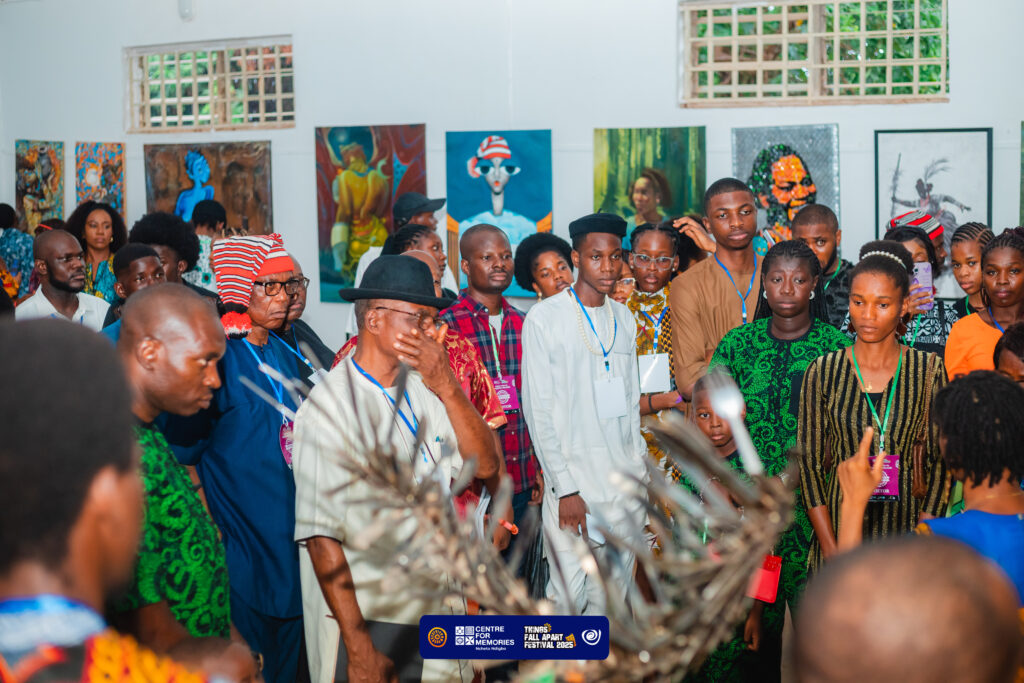
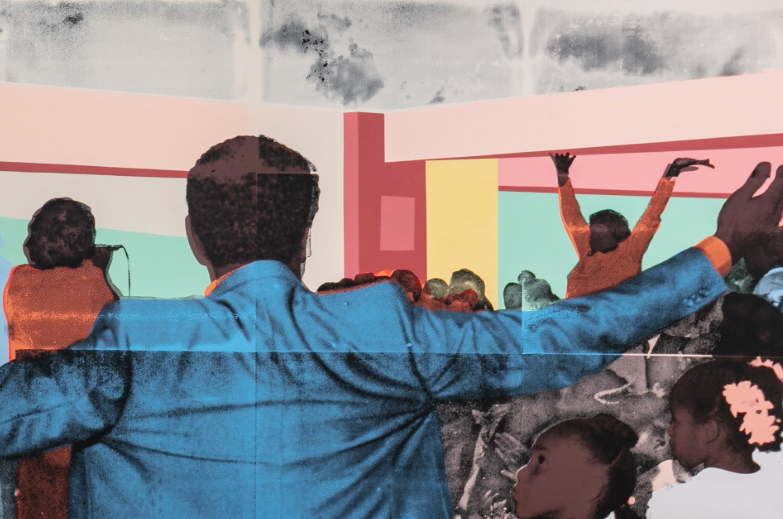
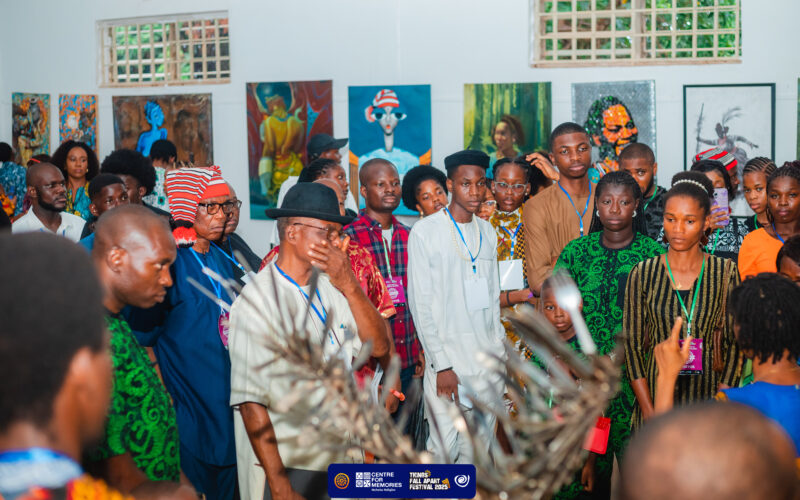
The call for submissions invited Nigerian artists to reimagine the story’s fictional village, Umuofia, through their art. Made from a wide range of media—photography, illustration, digital art, sculpture, mixed media and installations—48 pieces were exhibited. All of these drew inspiration from the novel, Igbo cosmology, pre-colonial Igbo history, and contemporary issues in southeast Nigeria.
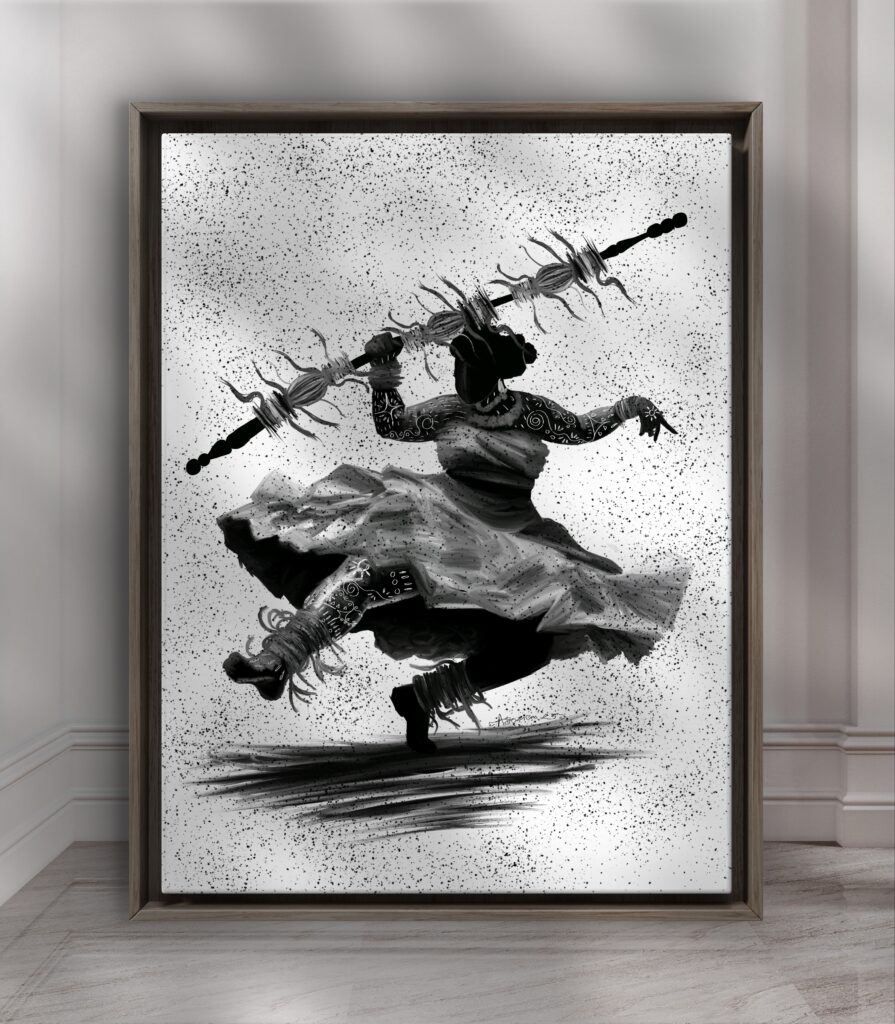
Chiagoziem Orji | Agbala (priestess) | 2 x 3 feet | digital art | 2025 | Photo credit: Centre for Memories
Among these, outstanding pieces came from Chiagoziem Orji and Ogochimere Onyeji, both alumni of Nsukka Art School. Chiagoziem’s work portrayed Chielo, a prominent female figure in the patriarchal world of Things Fall Apart and Igbo spirituality through digital art.
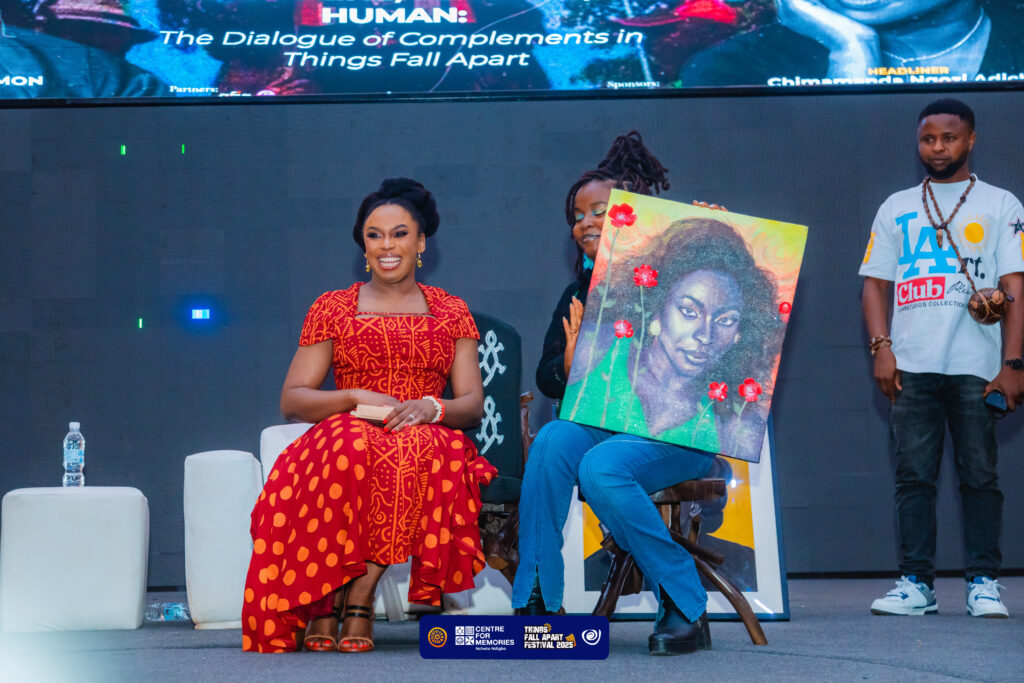
Ogochimere Onyeji and Chimamanda Ngozi Adichie at the Things Fall Apart Festival | Photo credit: Centre for Memories
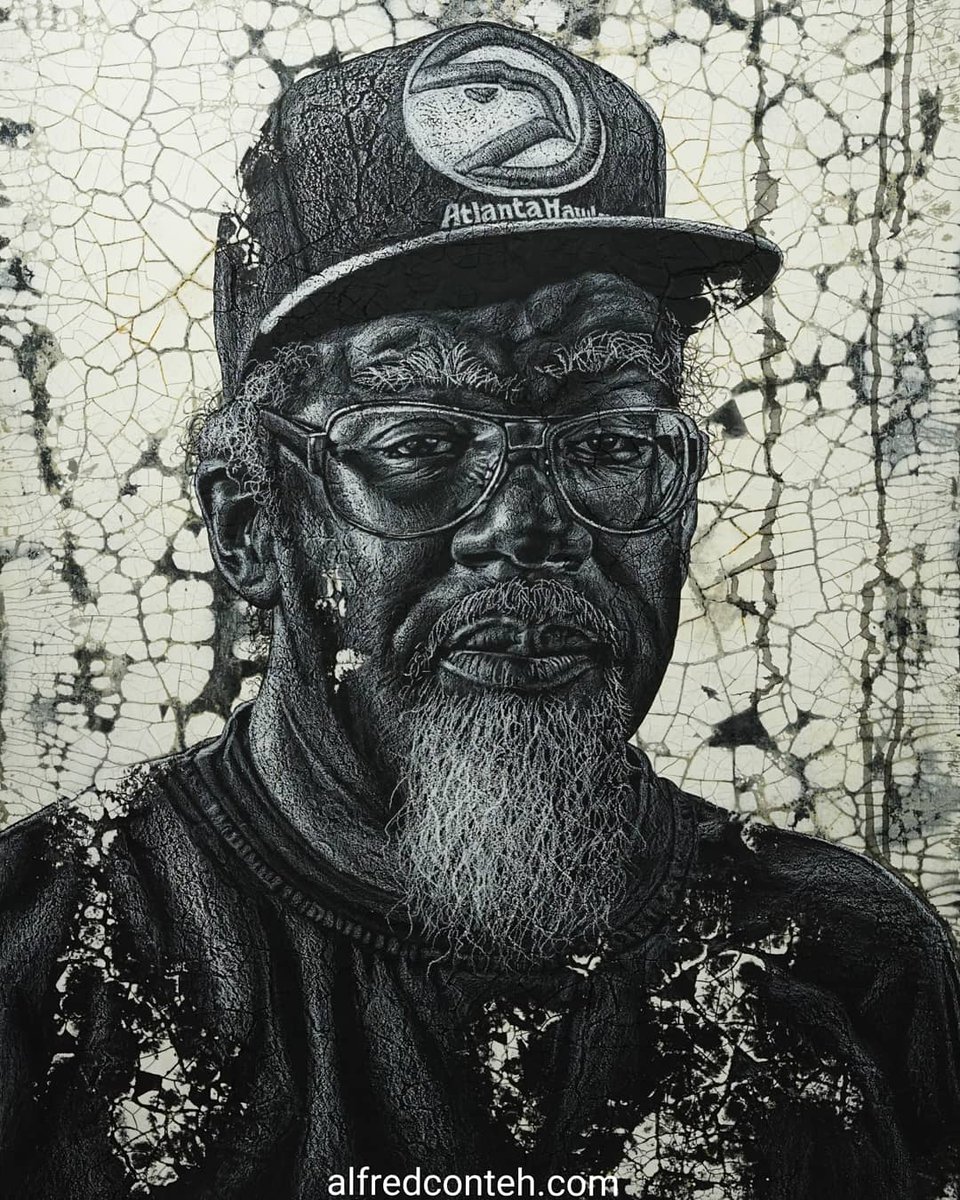
Ogochimere used acrylics and recycled plastics for her pieces, including a portrait of Chimamanda Ngozi Adichie, who received it at the festival’s finale.
To ensure that the exhibited pieces reflected the festival’s theme, participating artists were screened by Iheanyi Igboko, executive director of CFM, artist and curator Moses Ibanga, his assistant Izuchukwu Muoneme, and exhibition catalog producer Ayo Adewunmi, Ph.D., faculty member at the Institute of Management and Technology, Enugu.
Moses Ibanga started curating art exhibitions in 2004. A renowned painter and mixed media artist, he ensured that the festival’s outdoor physical setting reflected the novel’s original themes. The exhibition hall and its pieces also echoed a visual documentation of the novel’s translation into modern society.
In speaking with Moses Ibanga and Iheanyi Igboko, I got to see Umuofia through the eyes of other artists after the exhibition opening.

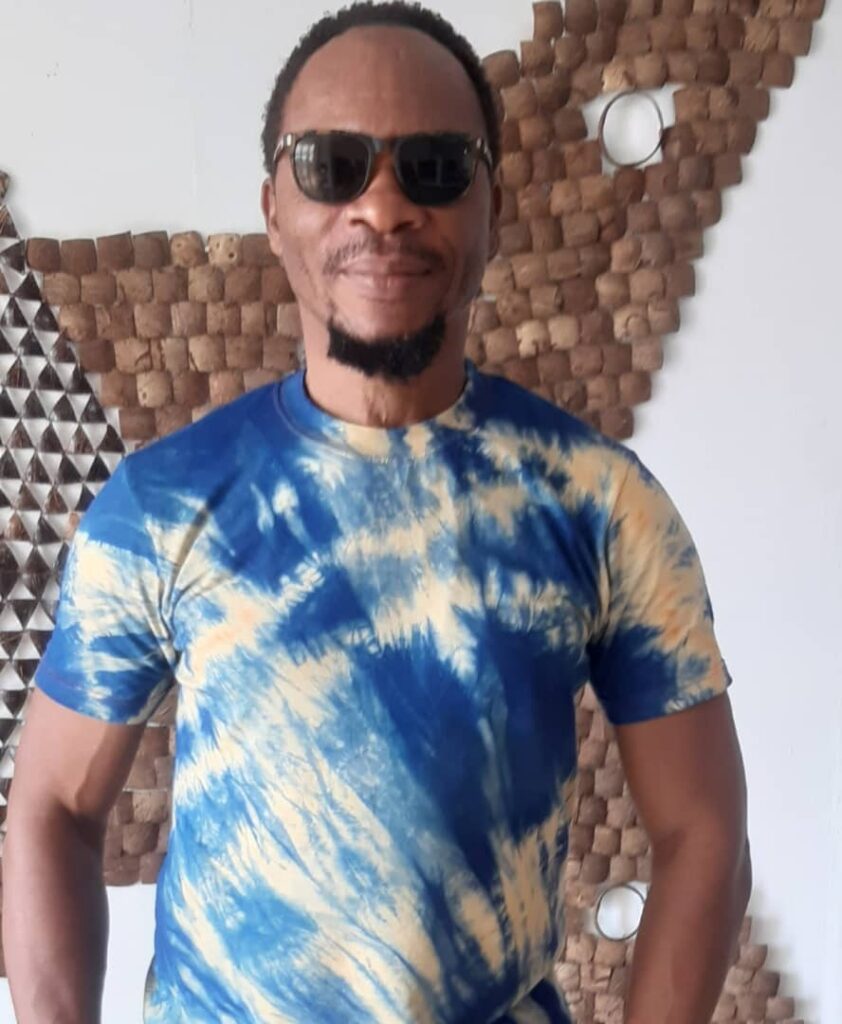
Rejoice Anodo (RA): How did the Centre for Memories aim to capture diverse perspectives on Achebe’s legacy through the art exhibition?
Moses Ibanga (MI): Some of the titles of the exhibited pieces were gotten directly from the novel. Outdoors, we set up a replica of Umuofia village, with mud huts, calabashes, and warriors guarding the village. The indoor hall of the exhibition showed a reinvention of Things Fall Apart itself and a visual representation of what Chinua Achebe wrote in his novel.
Iheanyi Igboko (II): Our overarching aim for the Things Fall Apart Festival is to capture Achebe’s legacy not as a relic, but as a living conversation with the present. Through this exhibition, we sought to foreground the multiplicity of perspectives in Things Fall Apart and to reflect how Achebe’s work continues to resonate across generations, cultures and artistic vocabularies. I believe we achieved this.
The exhibition hall became a dialogue of voices simultaneously: masculine and feminine, ancient and contemporary, celebratory and mournful. Visitors encountered works that challenged them to rethink their understanding of Achebe, as well as their understanding of themselves and their communities.
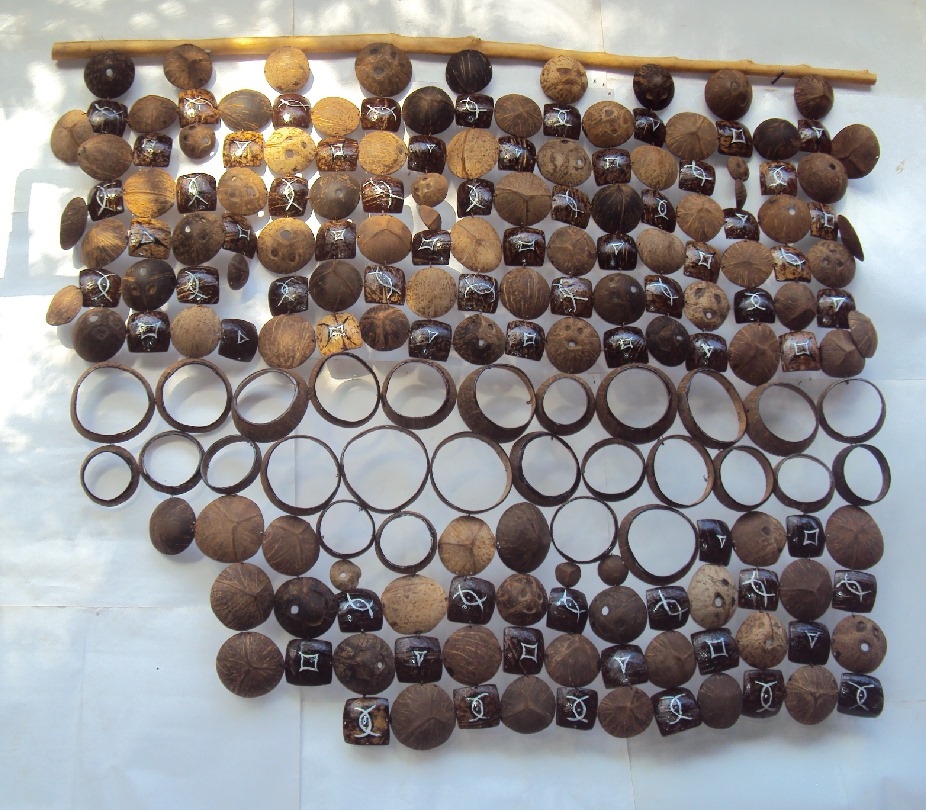
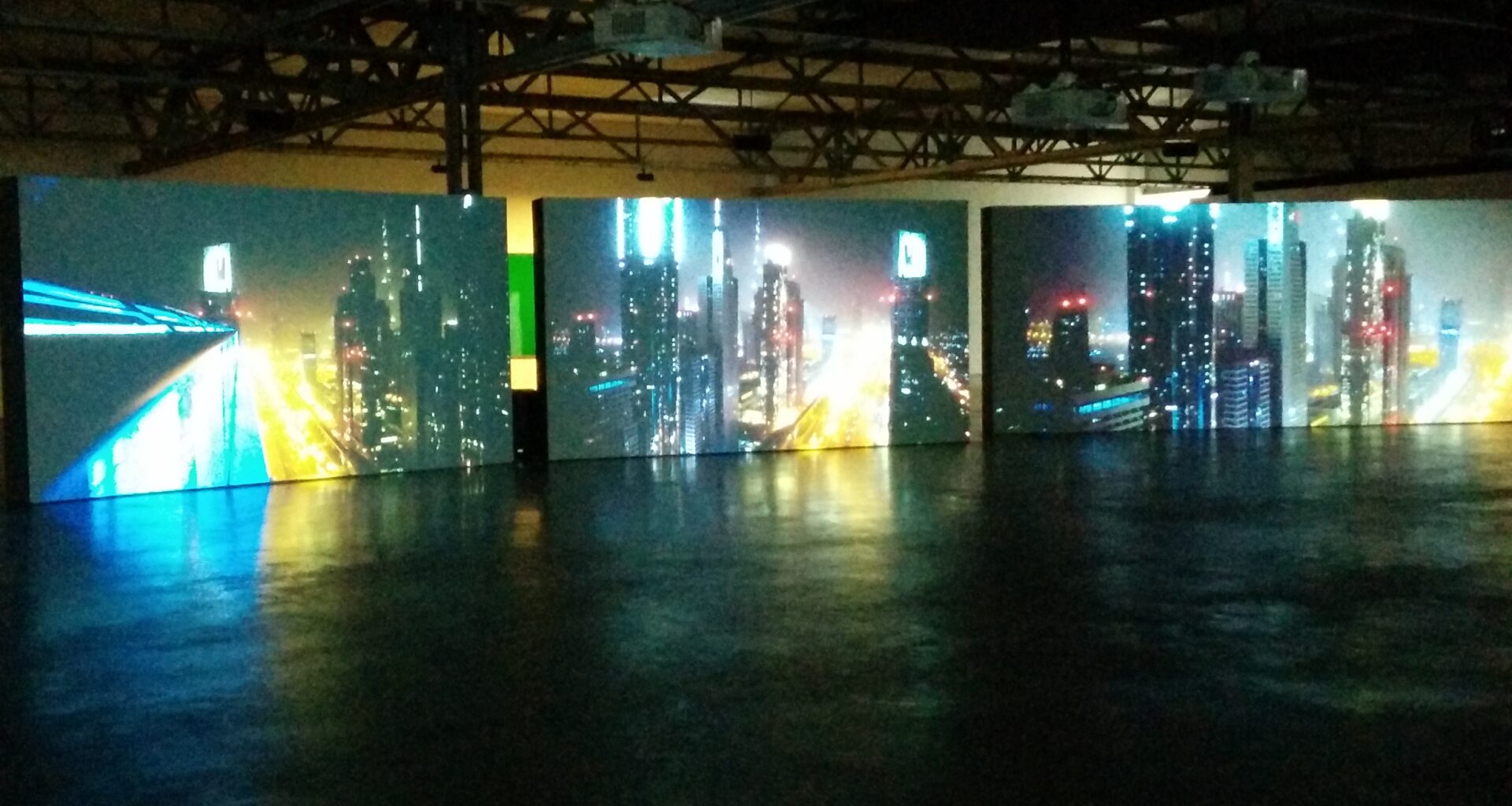
JK Meoli | Izu (a call for urgent meeting) | 3 x 4 feet | coconut shell waste, sculpture installation | 2025 | Photo credit: Centre for Memories
Perhaps most importantly, the exhibition engaged directly with urgent social concerns facing Ala Ìgbò today. Many of the festival’s events called for unity, cultural preservation, and renewed identity, and the art exhibition echoed these calls through a deeply symbolic lens. For example, the work, Izu, by JK Meoli, meaning “a call for an urgent meeting,” evokes the communal assemblies of Umuofia, where critical matters were discussed and collective wisdom prevailed. Izu is not merely aesthetic; it is symbolic of the need for Ndị Ìgbò to reunite the fragmented halves of our collective self.
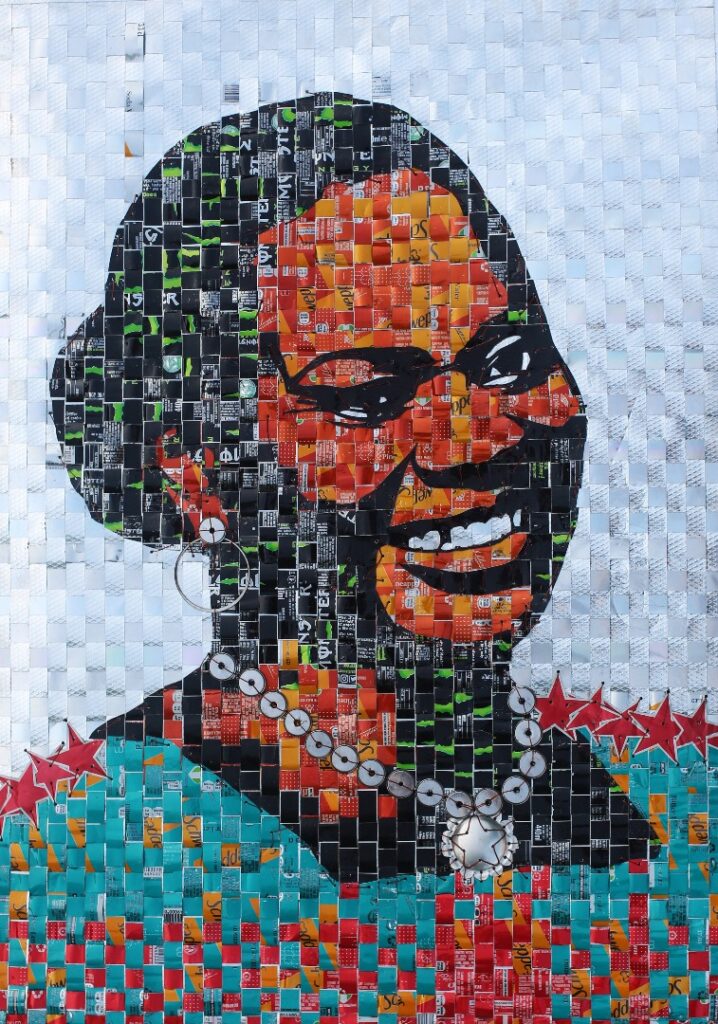
Chibuike Ifedilichukwu | Nkem (mine) | 26 x 36 inches (66 x 92 centimeters)| nkaute (aluminium and copper wire) | 2024 | Photo credit: Centre for Memories
Portraits of Chimamanda Ngozi Adichie and Dora Nkem Akunyili, rendered in nkaute—mat art and inspired by characters such as Ekwefi, Ezinma, and Chielo, highlight the central role of women as custodians of ritual and resilience. They remind us of the often-overlooked ways women hold communities together. The soft, yet tensile quality of the mat embodies both nurturing and resistance, symbolizing the strength required to sustain community when formal structures collapse.
In contrast, Chimamanda and Dora foreground the feminine as a force of continuity and cultural preservation. Mixed-media works incorporating modern materials with indigenous motifs highlighted the ongoing negotiation between tradition and modernity. In this way, the art exhibition not only honored Achebe’s vision but also became a mirror for today’s struggles, a space where the past illuminated the present, and the present reached back toward the past for wisdom.
RA: What criteria did the Centre for Memories use in selecting the participating artists?
II: In selecting participating artists, we were deliberate. We invited works that directly responded to the heartbeat of the novel: its characters, its tensions, and its haunting questions. Our criteria were guided by the festival’s theme, “Masculine, Feminine, Human: The Dialogue of Complements in Things Fall Apart.”
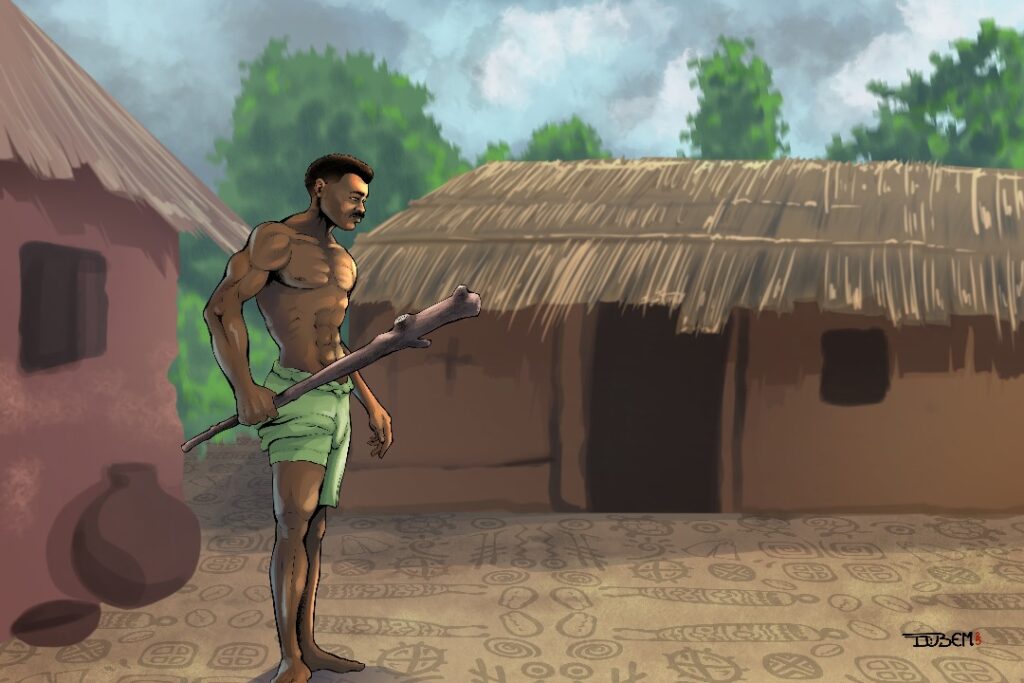
Chidubem Ekere | Okonkwo, |2 x 3 feet| digital illustration | 2025 | Photo credit: Centre for Memories
II: We looked for artists who could explore the novel’s symbolic figures and cultural expressions through the prisms of identity, resilience, spirituality, gender and the negotiation between tradition and change. We prioritized works that illuminated:
- The fraught weight of masculinity through figures such as Okonkwo, Unoka, Obierika, Ogbuefi Ezeudu, Ikemefuna, and Nwoye.
- The resilience, intuition, and often-overlooked authority of women: Ekwefi, Ezinma, Chielo and Chika as carriers of continuity and memory.
- The power of rituals, festivals and oral traditions as agents of cohesion in a fragile society.
- The collapse of worlds and the fragile survival of communities under pressure from colonial and cultural disruption.
RA: Many of the events at the Things Fall Apart Festival spoke to issues facing Igboland, including calls for unity and cultural preservation. How did the art exhibition engage with these urgent social concerns?
MI: The exhibition awakened and created a certain kind of consciousness in the minds of people that attended the exhibition. It presented a historical document of the past and the present and engaged every individual that came into the hall. A lot of people attended the exhibition. They engaged with each other and had a uniform presence. This created a sense of unity.
The presence of Chimamanda Ngozi Adichie, a literary artist, also spurred people. Art is a tool that brings life and unity among people. If the Things Fall Apart Festival becomes a continued practice, I believe it will promote unity among Igbo people.
RA: Did the exhibition provoke particular conversations among the visitors about the Achebean legacy that moved or surprised you?
MI: I overheard some of the visitors say they had heard of Chinua Achebe, but they had not read Things Fall Apart. With my experience over the years, I know what art is capable of. Coming into that experience of witnessing the novel’s visual depiction during the exhibition enlightened their understanding of what Things Fall Apart was all about.
The Things Fall Apart Festival art exhibition was on display at the Centre for Memories from June 29-July 5.