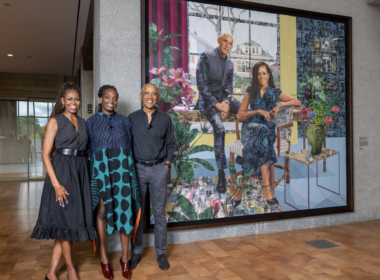


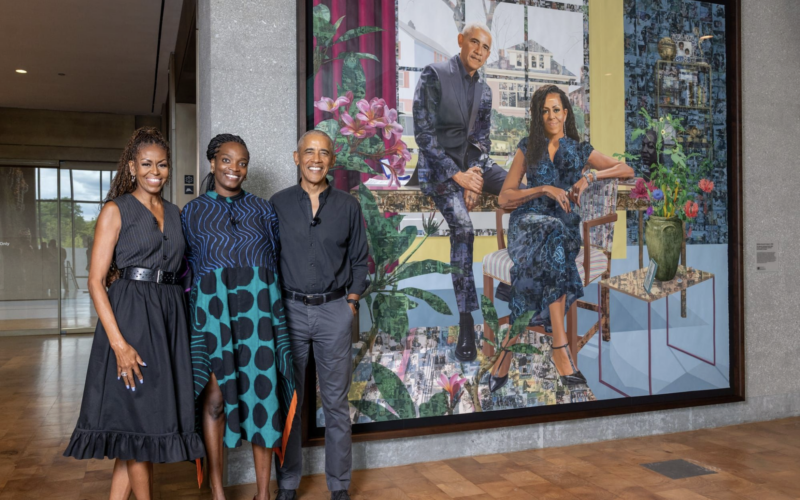
Above: Njideka Akunyili Crosby with the Obamas (Image courtesy the Obama Foundation)
This week’s stories revolve around a common act of inheritance. Across archives, museums, prizes, and institutions, Black artists and cultural workers are shaping not only what is seen today but what will be retained into tomorrow. This legacy includes the digitization of Richard Samuel Roberts’ century-old photographs, Njideka Akunyili Crosby’s monumental portrait of the Obamas, and many more not listed here. These stories reveal an ongoing commitment to preserving memory while expanding contemporary cultural narratives. Elsewhere, Otobong Nkanga’s latest international honor, Angels and Muse’s investment in curatorial education, and Misan Harriman’s departure from one of Britain’s foremost arts institutions underscore the evolving infrastructures through which Black art continues to be documented, interpreted, and sustained.
University of South Carolina Opens Richard Samuel Roberts Digital Archive
One of the most significant acts of cultural preservation this week came not from a museum exhibition but from a digital archive. The University of South Carolina Libraries has launched an online repository containing more than 5,000 photographs by African American photographer Richard Samuel Roberts, making a remarkable visual record of Black life in the segregated American South freely accessible for the first time.
Working in Columbia, South Carolina, during the early decades of the twentieth century, Roberts balanced his job as a postal worker with a thriving photography practice in the city’s Black business district. His portraits documented weddings, family gatherings, church communities, civic organizations, and everyday life, creating an intimate counter-archive to the stereotypes and omissions that dominated official histories of the Jim Crow era.
The collection, acquired by the university in 2020 and digitized with support from student researchers and the Center for Civil Rights History and Research, invites the public to contribute names, stories, and identifications for the photographs. Rather than presenting history as a finished record, the archive becomes a living document shaped by collective memory, ensuring Roberts’ images continue to recover overlooked histories for future generations.
Barack and Michelle Obama Unveil Joint Portrait by Njideka Akunyili Crosby
The Obama Foundation has unveiled the first official portrait of Barack and Michelle Obama together, commissioned from Nigerian-born, Los Angeles-based artist Njideka Akunyili Crosby ahead of the opening of the Barack Obama Presidential Center in Chicago.
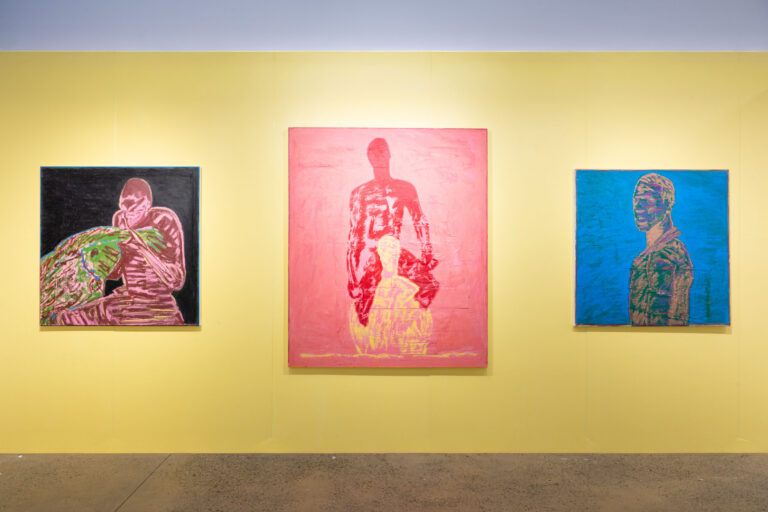
Titled The Obamas: Springing Forth (2026), the monumental painting draws on Akunyili Crosby’s signature photo-transfer technique, weaving together intimate family memories with symbols of the couple’s public life. References to Michelle Obama’s childhood home in Chicago, the Martin Luther King Jr. bust that occupied the Oval Office during Barack Obama’s presidency, photographs from the March on Washington, botanical motifs, and personal family images are layered throughout the composition.
The unveiling captured an emotional exchange between artist and sitters. Michelle Obama described the work as containing “all the stories within the story At the same time, Barack Obama paused before the canvas, remarking that it first needed to be absorbed before words could do it justice.
The portrait will greet visitors in the lobby of the Obama Presidential Center, where it joins new commissions by contemporary artists including Idris Khan and María Magdalena Campos-Pons, reinforcing the center’s commitment to placing contemporary art at the heart of public memory.
Otobong Nkanga Receives 2026 Sikkens Prize
Nigerian artist Otobong Nkanga has been named the recipient of the 2026 Sikkens Prize, one of Europe’s leading awards recognizing innovation in the use of color.
Awarded every two years, the prize honors artists whose practice expands the expressive and conceptual possibilities of color. The jury praised Nkanga for demonstrating that color extends beyond aesthetics, functioning instead as a language through which landscapes, ecology, labor, and community become interconnected.
The €75,000 (approximately $85,000 is US dollars) award includes funding for both personal artistic development and a color-focused public project, which Nkanga will direct toward initiatives through her Carved to Flow Foundation in Nigeria. The honor will coincide with Humus Blues, a major solo exhibition opening at Singer Laren in the Netherlands later this year, bringing together sculpture, textiles, drawing, painting, photography, and poetry from across her multidisciplinary practice.
The award further consolidates Nkanga’s position as one of the most influential contemporary artists working internationally, following recent recognition, including the Nasher Sculpture Prize.
Angels and Muse Commences Its 2026 Curatorial Intensive in Benin City
Angels and Muse has commenced its 2026 Curatorial Intensive at Black Muse in Benin City, bringing together curators, researchers, thinkers, and cultural practitioners for five days of critical exchange around African curatorial practice.
Supported by the Gwaertler Stiftung, this year’s program explores heritage, memory, displacement, and regional cultural infrastructures while challenging dominant exhibition models through indigenous knowledge systems and locally grounded methodologies.
The program focuses on three core pillars: Heritage & Memory, Displacement & Marginality, and Regional Infrastructures. Led by Ghanaian curator R. Esinam Damalie, whose sessions focus on Alternative Ways of Curating from Africa, guest facilitators include writer and curator Roli O’tsemaye, leading a workshop on Curatorial Writing Using Curatorial Embodiment as a Case Study; curator and researcher Kwasi Ohene-Ayeh, examining Indigenous Knowledge as Curatorial Methodology; and curator Lynhan Balatbat-Helbock, exploring Curating in the Global North with Global South Knowledge: Challenges, Contradictions, and Possibilities.
Originally launched online in 2024, this year’s edition of the Curatorial Intensive marks its first in-person edition. By hosting the program at Black Muse in Benin City, Angels and Muse continues its efforts to strengthen curatorial discourse beyond Africa’s established metropolitan art centers, creating space for critical engagement with history, memory, and contemporary cultural practice.
Misan Harriman to Step Down from Southbank Centre Chairmanship
Photographer and activist Misan Harriman has announced that he will step down as chair of London’s Southbank Centre, ending a tenure that has recently attracted intense public scrutiny.
Although the announcement follows weeks of attacks from right-wing British newspapers accusing Harriman of antisemitism over his social media posts concerning Palestine and British politics, both Harriman and the Southbank Centre maintain that the transition had been planned since January as part of the normal conclusion of his second term.
More than 100,000 people signed an open letter rejecting what supporters described as a coordinated smear campaign, with artists and public figures including Brian Eno, Tracey Emin, and Greta Thunberg expressing solidarity.
Harriman, who made history in 2020 as the first Black photographer to shoot the cover of British Vogue (September issue), remains one of Britain’s most prominent cultural figures working at the intersection of photography, activism, and public life. His departure closes an important chapter for one of the United Kingdom’s leading arts institutions while broader debates around artistic freedom, political expression, and institutional leadership continue.
Compiled by Roli O’tsemaye