
This week in Black Art and Culture holds exciting stories in refreshingly different geographies. In Naples, three Ghanaian boats emerge from the ground; in Milan, clay becomes a language for memory and belonging. Across the Atlantic, a painting removed from a diplomatic space exposes the fault lines between art and political power. And in London, a Zimbabwean writer receives one of African literature’s most recognised honours for a story rooted in the fragile negotiations of family life.
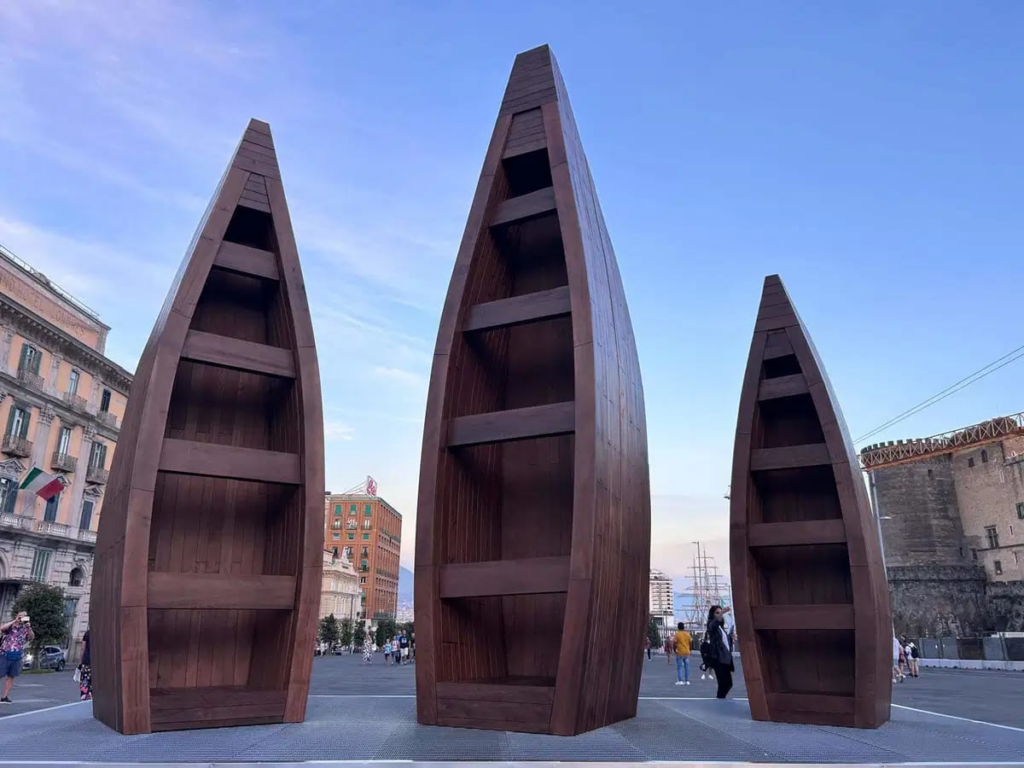
Ibrahim Mahama’s Voyageur Brings Ghanaian Boats to the Heart of Naples
Three wooden boats stand upright in Piazza Municipio, Naples, their hulls appearing to sink into the earth. Unveiled on 21 September, Voyageur, a new public installation by Ghanaian artist Ibrahim Mahama, places vessels built according to traditional Ghanaian techniques in an unexpected Mediterranean setting.
Curated by Vincenzo Trione and commissioned through the City of Naples’ Napoli Contemporanea programme, the installation comprises three boats measuring approximately five, seven and eight metres in height. They remain on view until 18 November 2026.
Positioned between the city and its port, the boats bring two maritime histories into proximity: Ghana’s Atlantic coast and Naples’ long relationship with the Mediterranean. But Mahama’s vessels are not going anywhere. Their vertical orientation and partial burial interrupt the familiar image of a boat as an instrument of passage, transforming it instead into something resembling an archaeological remnant.
The work draws attention to the histories carried by objects as they move between places: the circulation of goods, the demands of labour, migration, displacement and cultural exchange. By bringing Ghanaian boatbuilding into the heart of Naples, Mahama makes the city a meeting point for histories that are often narrated separately.
Here, the boat is both a means of movement and a monument to everything movement leaves behind.
Six Black Artists and Writers Named 2026 MacArthur Fellows
From the improvisational possibilities of jazz to the political charge of contemporary art, dance and fiction, six Black creatives have been named among the 2026 MacArthur Fellows, receiving recognition for practices that expand how we understand and experience the world.
The recipients include saxophonist and composer Immanuel Wilkins, whose music draws on the histories and possibilities of jazz; visual artist Rodney McMillian, whose work examines the entanglements of race, class, politics and everyday life; and choreographer Trajal Harrell, who brings diverse movement traditions into dialogue, challenging established boundaries between dance forms.
They are joined by writers Bryan Washington, whose fiction explores intimacy, identity and the complexities of human relationships, and Maaza Mengiste, whose literary practice engages with history, memory and the legacies of political violence. Together, their work moves across forms and disciplines, revealing the many ways Black artists and storytellers interrogate the present while reckoning with the past.
The MacArthur Fellowship, widely known as the “genius grant”, provides each recipient with $800,000 over five years, without restrictions on how the money is spent. The support offers artists and thinkers room to pursue ambitious work on their own terms, beyond the immediate demands of institutions and conventional funding structures.
For these five cultural practitioners, the recognition affirms the significance of practices that resist easy categorisation and continue to reshape contemporary artistic and literary discourse.
Bisila Noha Wins Tacchini Prize with Ceramics That Hold Stories of Belonging
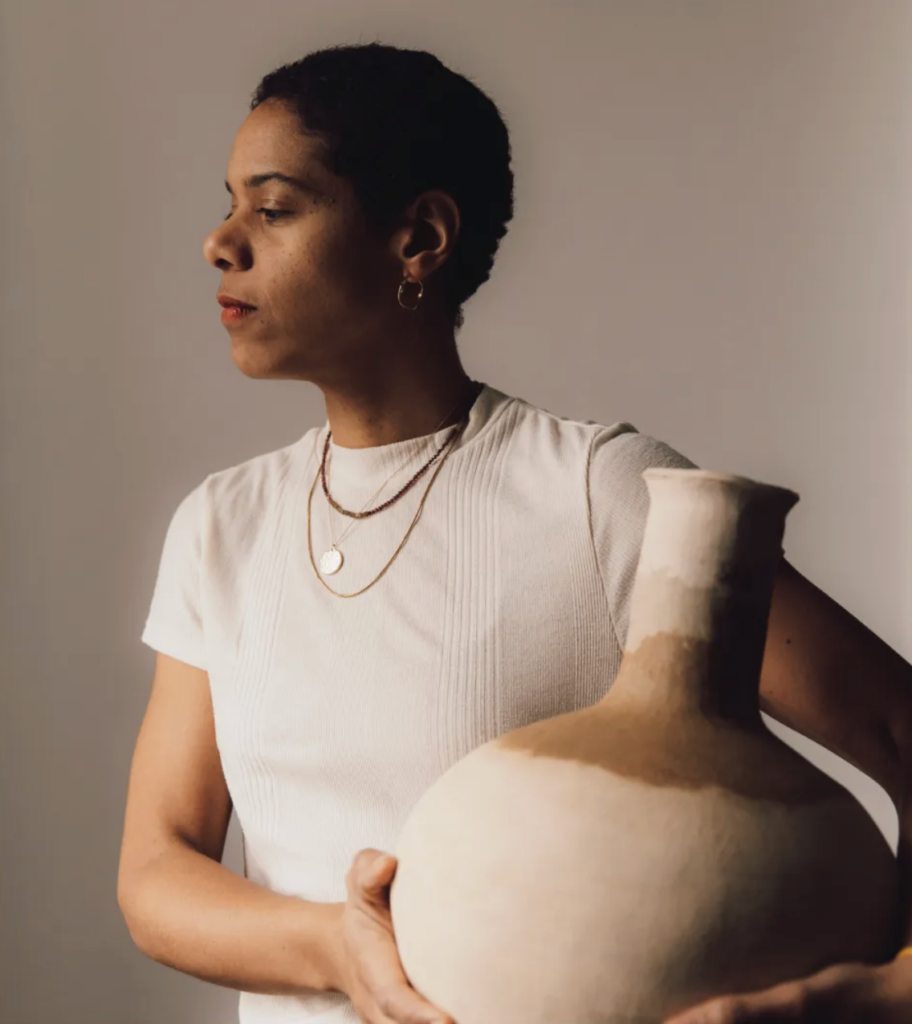
What can a vessel remember? What can they tell us? For Spanish-Equatoguinean artist Bisila Noha, ceramics offer a way to explore what survives, what is transmitted and what changes across generations.
Noha has received the Tacchini Prize, awarded in collaboration with Fondazione Officine Saffi, which supports contemporary ceramic practice. The recognition accompanies A Tactile Story, an exhibition at Casa Tacchini, the Italian furniture brand’s Milan showroom, on view until 13 November 2026.
Her sculptural works occupy the domestic interior in unexpected ways. Vessels that appear cracked or disintegrating hang from ropes; four-legged forms stand in an illuminated corner; a monumental pot with gradated colours occupies the window. Placed alongside furniture, these objects unsettle the distinction between the functional and the expressive, asking viewers to encounter ceramics not simply as vessels but as forms that carry meaning.
The exhibition brings artistic research into dialogue with design, while foregrounding Noha’s engagement with identity, memory and belonging. Clay becomes a material through which inherited histories can be held, reshaped and communicated.
In this encounter between sculpture and domestic space, the familiar object acquires another life. What might ordinarily contain water, food or other necessities instead holds the traces of experience, suggesting that materials can preserve stories even as those stories continue to evolve.
Kehinde Wiley Seeks to Buy Back Painting Removed from US Embassy
A painting commissioned to foster cultural exchange has become the subject of a political dispute over which forms of representation are permitted in public institutions.
Kehinde Wiley has asked to buy back Young Artists After Siamesas 1960 (2015), removed from the United States Embassy in Santo Domingo, Dominican Republic, in August. In a letter dated 24 September to President Donald Trump, the artist requested the opportunity to reclaim the work after the State Department began considering whether it could be sold.
The painting was commissioned through the State Department’s Art in Embassies programme. Wiley studied Dominican artists and worked with young art students in Santo Domingo in developing the work, which depicts four Dominican individuals against a floral backdrop. Officials, however, criticised the painting as embodying what they described as “woke” ideology.
Wiley’s request is therefore about more than recovering a single artwork. It brings into focus the contradictions of cultural diplomacy: institutions may commission art to represent cultural exchange, yet political changes can alter which histories and images they are willing to display.
The dispute also raises a question of artistic ownership and institutional responsibility. If a government no longer wishes to exhibit a work it commissioned, what obligations does it have to the artist and the people represented?
Wiley has made his position clear: the painting remains important to him because of the people and ideas it represents. Its removal has turned an artwork intended to facilitate exchange into a test of how far that exchange is allowed to go.
Zimbabwean Writer Simbarashe Steyn Kundizeza Wins £10,000 Caine Prize for African Writing
Zimbabwean writer Simbarashe Steyn Kundizeza has won the 2026 Caine Prize for African Writing for The Blue Fighter, a short story published by The Shallow Tales Review in 2025. The £10,000 award was announced in London on 7 October.
At the centre of Kundizeza’s story is Tinashe, a young boy whose family begins to unravel financially after his father abandons his profession to pursue a passion for building fish tanks. As money dwindles, Tinashe’s mother must confront the cost of sustaining her husband’s dream against the immediate needs of her family.
The story’s power lies in this intimate conflict, where ambition and devotion collide with economic precarity. Rather than treating family as a source of uncomplicated solidarity, Kundizeza explores the difficult choices through which love, responsibility and disappointment become entangled.
Chair of judges Bola Mosuro praised the story’s emotional force and craftsmanship, highlighting its treatment of denial, frustration, loyalty and quiet strength.
Based in Harare, Kundizeza is an associate editor at African Writer Magazine. His debut novel manuscript, Freelance, won the 2024 Island Prize for Debut African Fiction. He was selected from a shortlist of five writers representing Zimbabwe, Kenya, Cameroon, Nigeria and Egypt, from a field of 407 submissions across 27 African countries.
Established in 2000, the Caine Prize has become an important platform for African short fiction. Kundizeza’s win adds another voice to a literary tradition that continues to find expansive human questions in the particulars of everyday life.
Compiled by Roli O’tsemaye