
Some weeks, the question is not simply what is happening, but who gets to decide what matters. Who gets to tell a nation’s story, whose image is allowed to stand on a wall, whose music becomes part of the world’s soundtrack, and whose stories travel far enough to be heard. This week, those questions surfaced in unexpected places, from museum halls and diplomatic offices to Hollywood Boulevard and the pages of a young adult novel. Meanwhile, a cultural institution with more than five decades of history prepares to return to television. Here is what caught our attention.
Lonnie Bunch to Leave the Smithsonian After Seven Years as Secretary

Lonnie G. Bunch III, the first Black person to lead the Smithsonian Institution, has announced that he will retire as secretary at the end of 2026. Bunch has spent nearly 38 years at the Smithsonian, including 14 years as founding director of the National Museum of African American History and Culture before becoming secretary in 2019.
His departure comes at a particularly consequential moment for the institution. The Smithsonian has faced sustained criticism from the Trump administration over its presentation of American history, with officials accusing its museums of promoting what they describe as divisive or anti-American narratives. Bunch has repeatedly defended the institution’s commitment to scholarship and a fuller account of the country’s past.
His tenure included the opening and establishment of the National Museum of African American History and Culture, for which he secured significant congressional and private funding and oversaw the development of its National Mall building.
Bunch said his decision came with “very mixed emotions and heartfelt gratitude”, adding that the Smithsonian had been one of the great loves of his life. He is expected to remain in the role through the transition to his successor.
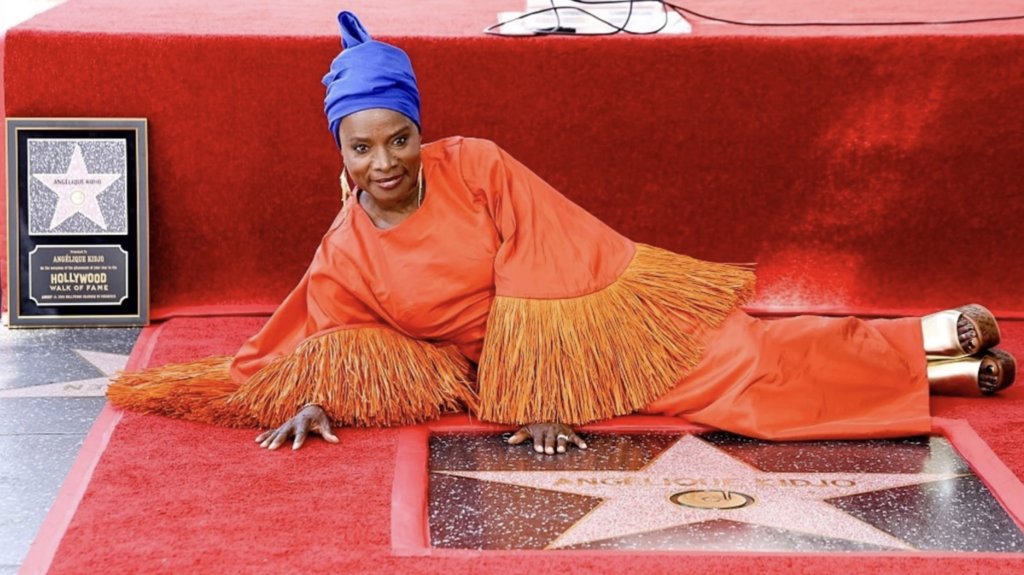
Angélique Kidjo Becomes First African Musician with a Hollywood Walk of Fame Star
Beninese singer Angélique Kidjo has become the first African musician to receive a star on the Hollywood Walk of Fame, marking another milestone in a career that has taken West African music to audiences around the world.
The five-time Grammy winner was honoured in Los Angeles on August 18 with the 2,854th star on the Walk of Fame, in the Recording category. The Hollywood Chamber of Commerce described her as the first African artist to receive the honour.
Kidjo, who has released 18 albums across a career spanning more than four decades, has built a distinctive musical language from West African traditions alongside funk, jazz, pop and R&B. Her international collaborations have included artists such as Burna Boy, Alicia Keys, John Legend and Bono.
At the ceremony, she reflected on the wider significance of the recognition, speaking about Africa’s foundational contribution to global music. She was joined by actor Willem Dafoe and Recording Academy CEO Harvey Mason Jr., among others.
The honour adds to a long list of international recognition for Kidjo, including five Grammy Awards and the 2023 Polar Music Prize. It also formally places one of Africa’s most influential contemporary musicians on one of Hollywood’s most recognisable cultural landmarks.
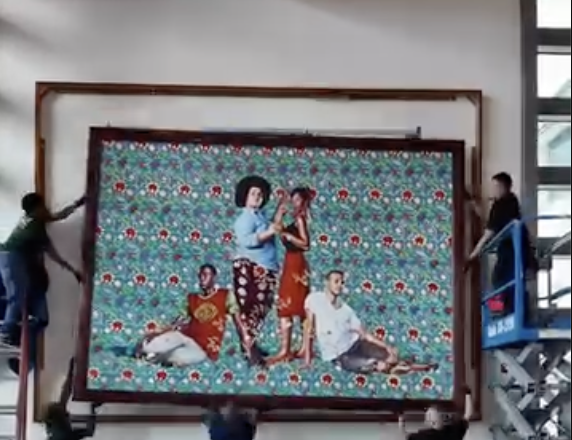
US Removes Kehinde Wiley Painting from Dominican Republic Embassy
A painting by Kehinde Wiley has been removed from the US Embassy in Santo Domingo, Dominican Republic, following criticism from Trump administration officials who described the work and the artist’s broader practice as incompatible with the administration’s political agenda.
Young Artists After Siamesas 1960 (2015) was commissioned by the US State Department’s Art in Embassies programme and features four Dominican models against a lush floral background. The work was removed from the embassy this month, with US Ambassador Leah Campos publicly celebrating the decision as part of what she described as a rejection of “globalist and woke ideologies”.
The State Department has also said it is consulting legal representatives to determine whether the painting can be sold. A department spokesperson cited comments Wiley made about another work, as well as sexual assault allegations against the artist, which Wiley has denied.
The removal is notable given the painting’s original purpose. Through Art in Embassies, the US government has historically used contemporary art to foster cultural exchange and represent American engagement abroad. Wiley was himself awarded the State Department’s Medal of Art in 2015 for his contribution to cultural diplomacy.
The episode reflects a broader shift in the programme under the current administration towards explicitly patriotic imagery and away from some of the more expansive cultural representation associated with previous years.
Zimbabwe’s Blessing Musariri Named a Finalist for the $50,000 Kirkus Prize
Zimbabwean author Blessing Musariri is the only African author among the finalists for the 2026 Kirkus Prize, earning recognition in the Young Readers’ Literature category for her young adult novel When It’s Your Turn for Midnight.
The novel follows 15-year-old Chianti Minana, who travels to her grandmother’s home in Mutare after learning that the man she has always called her father is not her biological father. There, she becomes entangled in the history of four elderly friends who fought together during Zimbabwe’s War of Independence.
Published in the UK in 2024 and in the United States in 2026, the novel explores family, memory, intergenerational silence and Zimbabwe’s history through Chianti’s discovery of old photographs and a wartime notebook.
Kirkus praised the book as “a sparkling jewel of a story grounded in emotional truths”, highlighting Musariri’s lyrical writing and attention to what remains unspoken between generations.
The Kirkus Prize is one of the major literary awards in the United States, with winners in each of its three categories receiving $50,000. Musariri will compete against Elizabeth Acevedo, whose Anger Is Only a Shadow is also a young adult finalist. The winners will be announced in New York on October 7.
The Soul Train Awards Are Returning After a Three-Year Hiatus
The Soul Train Awards are returning to television this November after a three-year hiatus, with the ceremony moving to Chicago, the city where Don Cornelius launched Soul Train in 1971.
BET announced that the 2026 ceremony will air on November 27 at 8 p.m. ET on BET and will be simulcast on CBS for the first time. It will also air across BET Her, VH1, MTV2 and Logo. The ceremony will be recorded in advance in Chicago and will celebrate both the artists who established the traditions of R&B and soul and those carrying the music forward today.
The Soul Train Awards last aired in 2023 before BET placed the programme on hiatus as it reconsidered the future of its awards franchises.
For its return, BET is introducing a new format that pairs established honourees with contemporary artists, connecting the history of Soul Train to the present-day evolution of Black music. Performers, nominees and the host have not yet been announced.
The original Soul Train ran for 35 years and became a defining platform for Black music, dance and fashion in American popular culture. Its return brings one of television’s most significant Black cultural franchises back to the city where it began.
Compiled by Roli O’tsemaye