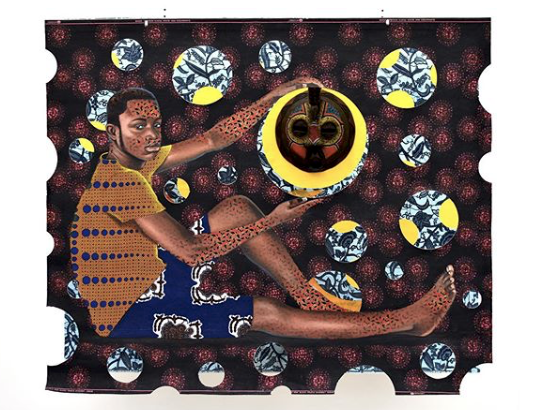




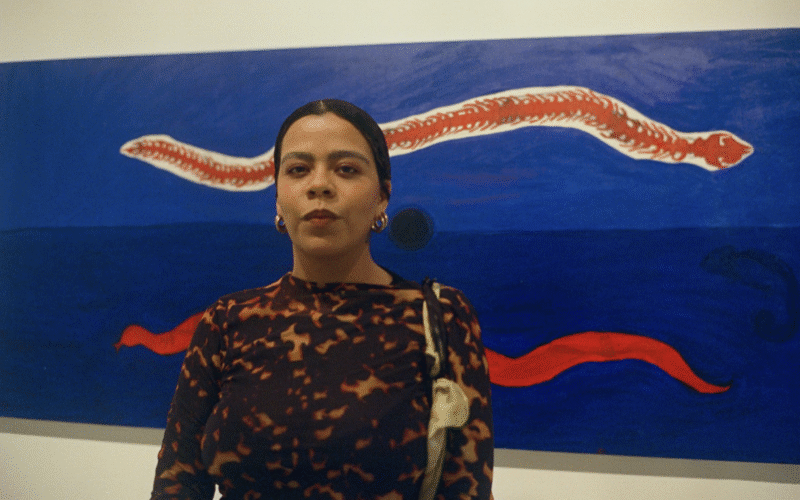
Above: Luara Macari’s portrait by Lia Morena | Courtesy of the artist
Luara Macari’s artistic path has been shaped largely by the unexpected turns of life—by events that led her to reflection or by people who pointed something out and shifted her direction. However, it was only five years ago that art truly became a life possibility for her. Around 2020, while studying architecture, Luara was going through an intense period of emotional struggle and mental health challenges. She often jokes that the official turning point in her journey toward the art world happened on her 21st birthday, when she received an astrological chart reading as a gift. During the session, the astrologer told her that her emotional imbalance stemmed from a creative drive that lacked proper direction. That perspective completely shifted how Luara saw herself.
Today, she is much more connected to painting, but five years ago, her entry into the art world began with photography. She only started photographing after a conversation with her grandfather, who revealed he had kept an old camera—a Pentax K1000 he had owned since the late 1970s. Intrigued, she took the camera to be repaired, bought film and began to explore this mysterious device. It was only after that astrological reading that she moved beyond simply taking photographs and began building a visual language through photography. By the end of 2020, she produced her first fully artistic work—the series Rompe Demanda—a photo-performance that enacted a symbolic ritual and marked her entry into the expanded field of visual arts.
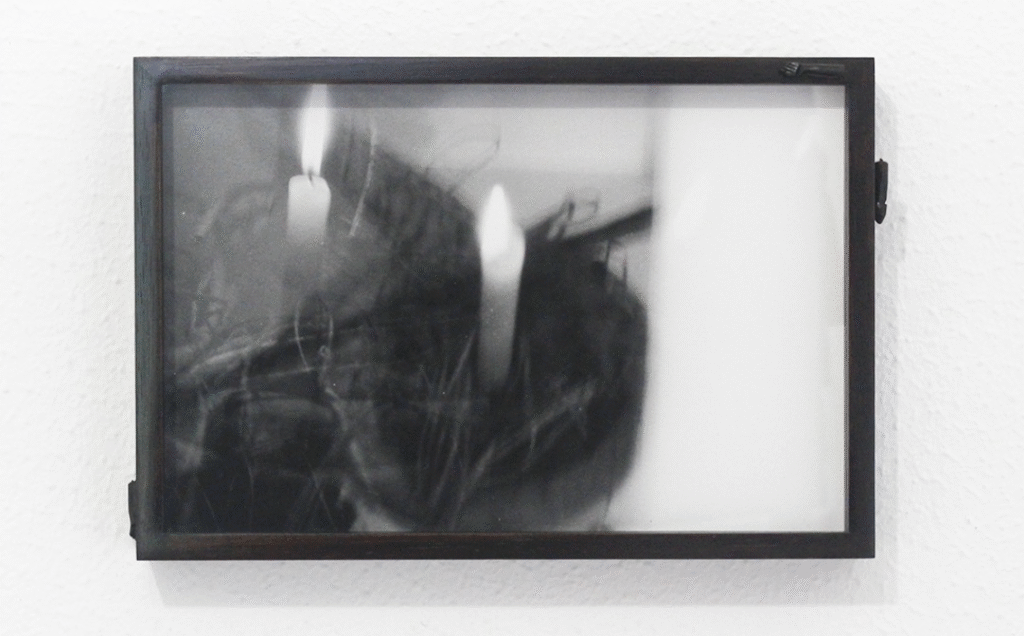
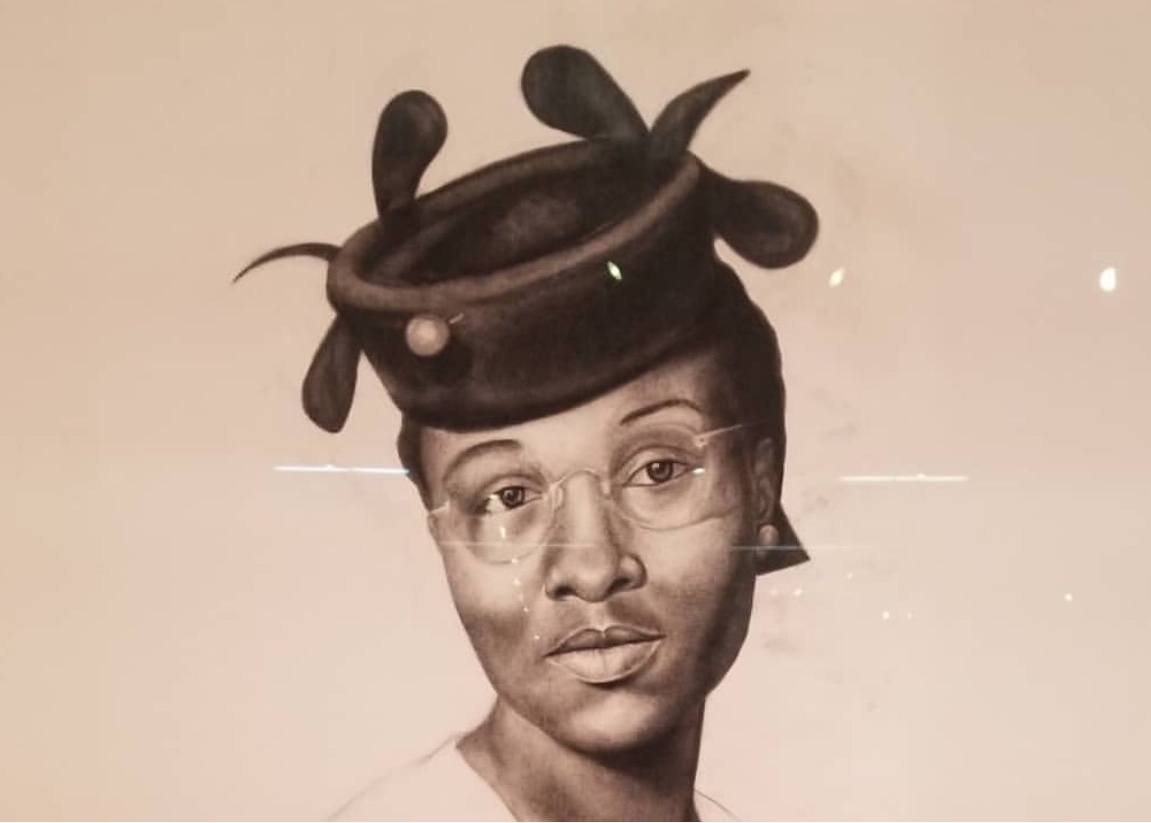
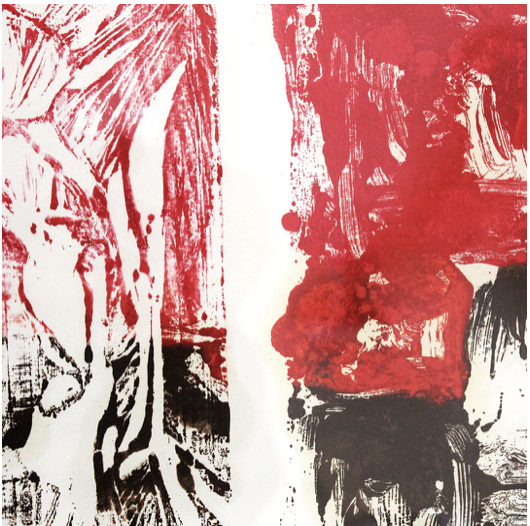
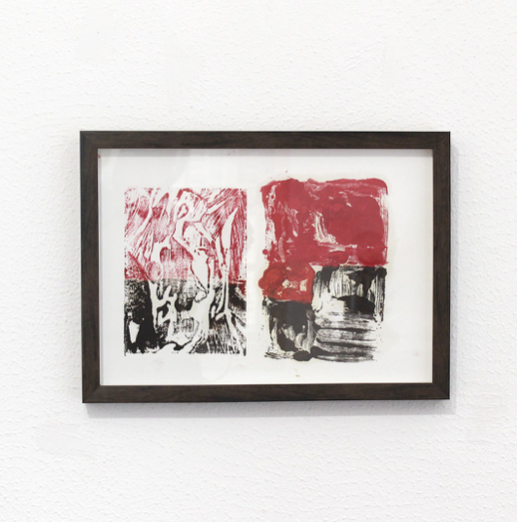
Luara Macari | Untitled 2 | 23.5 x 34.5 centimeters | 2021 | Courtesy of Lateral Galeria
Luara’s current research is closely connected to Yoruba cosmology and the stories surrounding the formation of the Earth and its inhabitants. However, beyond the specific subject matter of each phase, her research is consistently guided by dialogue with art history, philosophy and literature. Before sitting down in the studio to begin any work, she dedicates time to reading—a process of connecting with what has already been created by other artists who move her in some way.
Her studio is always filled with exhibition catalogs and art history books. Her computer is always open and ready for deeper exploration into the language of an artist or the thinking of an author she is studying, whether independently or at university. There is always a piece of work that guides her toward a new compositional possibility or inspires a different color palette.
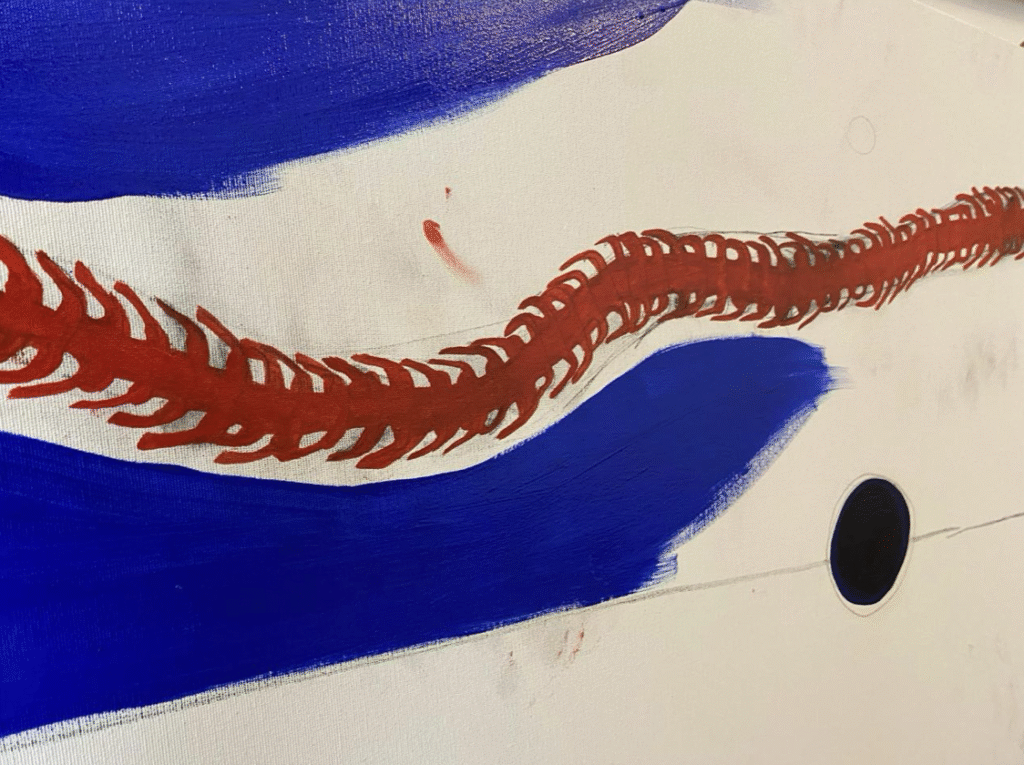
Work in progress of Então se fez anoite | 2024 | Courtesy of the artist
Guilherme Marinho: Your practice spans multiple mediums. How do you navigate between these different formats and media?
Luara Macari: Yes, my practice really does move across several fields of language. At the moment, photography and printmaking are a bit more distant from the studio, but they’re techniques I don’t intend to abandon—they’re part of how I build my creative operations. Right now, painting is more at the center, but the way I paint isn’t “pure.” I borrow gestures and small technical fragments from other media. For instance, when I’m working on a canvas, I’m concerned with the paths the paint itself takes. Often, I begin a piece by applying paint to a piece of moist clay and pressing that same clay onto the canvas.
Just as I sometimes begin with impressions made using paint and clay, other times I start with a photograph I took to think through the structure of the composition. In other instances, I use sheets of paper to remove excess paint from areas of the canvas and later use that same paper to create drawings in graphite and charcoal. I think if we look at my poetic behavior—or rather, at how I use technique to build poetic meaning—I would say that this movement between media and formats is the foundation of my work. My pieces emerge precisely in those small moments of technical deviation that become embedded in the materiality of the artwork.
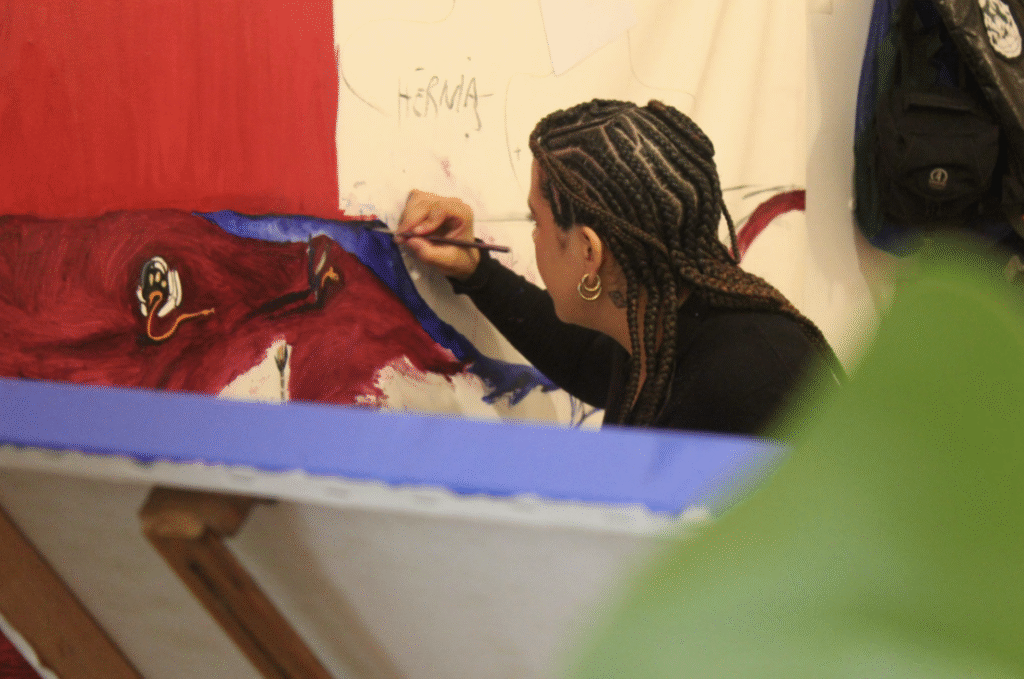
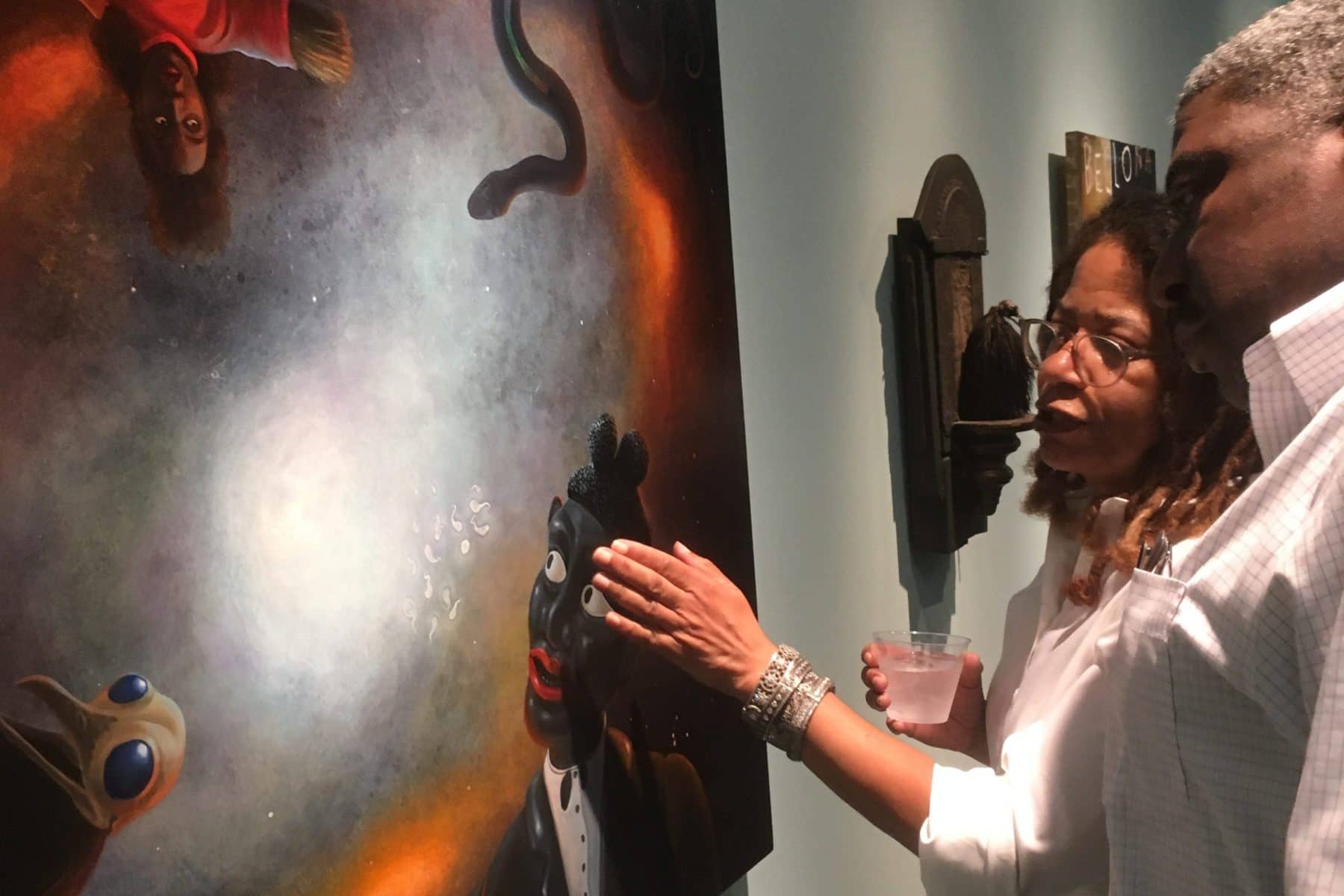
Luara Macari at her studio | Courtesy of Lateral Galeria
GM: Abstraction is a strong presence in your work, from photography to painting. What draws you to the abstract, and how would you describe your creative process?
LM:I’m not sure I’d call it abstraction—I’d say my interest lies in what exists beyond form, in what transcends visual appearance. I feel there’s a kind of power in deviation, in imprecision, in imperfection—that is, in the formal elements of an artwork that depart from reality. It’s through contact with these “strange” elements that I think it becomes possible to connect with the intention behind a work.
Structurally, what I’ve been producing follows a fairly familiar path in art history—figure and ground forming a landscape. Broadly speaking, my work doesn’t present major ruptures or new propositions. Artists like Frida Kahlo, Tarsila do Amaral (a Brazilian painter), and Pedro Figari (a Uruguayan painter) were already exploring similar approaches during the Latin American modernist period. And artists like Pol Taburet (French), Caio Pacela, and Dalton Paula (both Brazilian) are doing so today in contemporary art. In short, many artists have explored or are exploring this format, and I see my work as honoring their contributions.
Even from this place of revisiting—or rather, of historical continuity—I believe the strength of my work lies in the subtle deviations: in the moments when I transfigure reality in my own way. Whether that’s through using a palette of reds and blues to compose a landscape that, in a realistic depiction, would be formed with greens and browns—or through my disobedient appropriations of other techniques to make paintings.
GM:You also study curatorship and art criticism, and writing plays an important role in your process. What is the significance of writing about your own work, and how does it influence your visual production?
LM: Yes, I study art—specifically history, criticism and curatorship—at a very traditional university here in São Paulo called PUC (Pontifical Catholic University). For me, as an artist, it’s a constant conflict not to be academically close to studio-related subjects. But in Brazil—and across Latin America in general—we live in a reality where it’s almost impossible to survive solely as an artist. My decision to be closer to art history, philosophy, curatorial practices and exhibition-making comes from the understanding that, given the context Brazilian artists face, it’s essential to expand our fields of professional activity. And as we know, in art criticism, curatorship and art history, writing is the main language.
Beyond professional matters, though, writing has been part of my life from a very young age—long before I knew curatorship was a career path or even imagined becoming a professional artist. Reading and writing have always been long-standing habits. I’ve always been fascinated by literature’s power—whether philosophical or artistic—to transport us into a subjective space of constant imagining. When we read, we’re required to stay fully engaged, envisioning the landscapes or concepts being proposed. As the text unfolds, images, conflicts and ideas emerge, forming an archipelago of new possibilities.
I believe I’ve been writing about myself since early childhood—starting with made-up stories, and later, as a preteen, writing about the drama of beginning to understand myself as a person. But when I began working visually—or better, when I started realizing that what I was doing (photographing, drawing, painting, etc.) was visual art—I felt a strong creative need to articulate what interested and motivated me. Today, with a bit more maturity, I understand that what I’ve been developing by combining narrative writing and visual production is what we call process writing.
And for me, the texts I write are also artworks—they are just as much a part of my artistic practice as the visuals. Writing and visuality feed into each other, and my work only truly comes to life in that in-between space—the space between visual practice (painting, printmaking, photography, and so on) and writing.
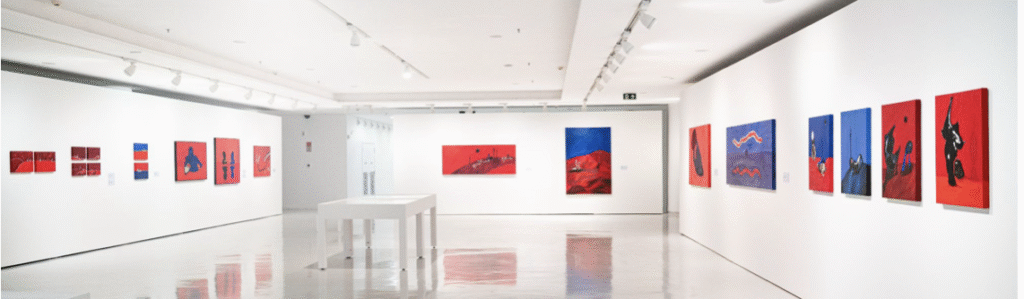
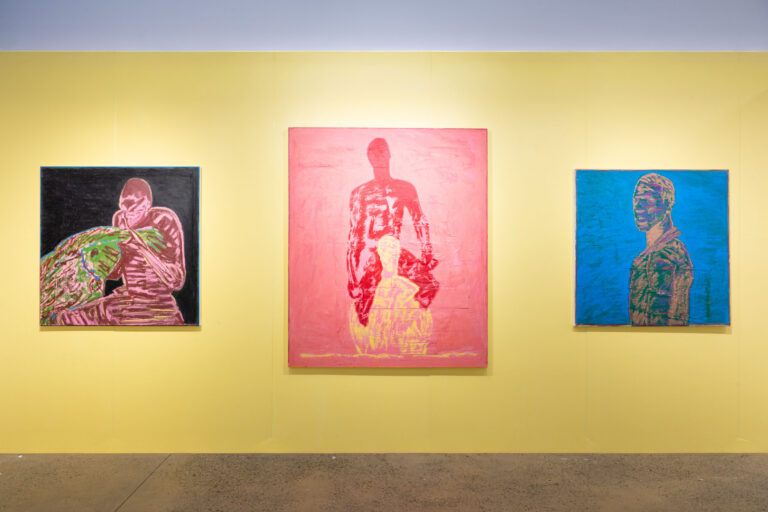
Panoramic view from the exhibition “Tudoquenascevermelho”at MAC-USP (Museum of Contemporary Art of the University of São Paulo) | Credit: Mayra Azzy | Courtesy of the artist
GM:You’re about to have your first solo exhibition at a major institution within the Brazilian art system—the Museum of Contemporary Art of the University of São Paulo (MAC-USP). What do you intend to present, and what is the significance of bringing this subject into a museum setting?
LM: Yes, MAC-USP—the Museum of Contemporary Art of the University of São Paulo. I’m not sure how widely known its institutional relevance is outside of Brazil, but within the country, it’s a hugely important center for contemporary art—for both artistic production and academic research. Since it’s a university museum—part of the largest university in Latin America—it also serves as a hub for knowledge production. Being there is something of unimaginable significance.
I could speak about this importance from many perspectives, but as a young Black artist who mobilizes ancestry to construct visual language, having my first solo show at MAC-USP is a way of claiming space—the same space occupied by major artists like Tarsila do Amaral, Max Bill, Di Cavalcanti, and many others.
GM:To wrap up, how can people follow your work, and where can they acquire your pieces?
LM: Although I tend to be a bit low-profile, my work can currently be followed on Instagram (@luarammmacari). My artworks are available through Lateral Galeria (@lateralgaleria) and Janaina Torres Galeria (@janainatorresgaleria).